Intracellular carbon storage enables starvation survival in marine bacteria

Intracellular carbon storage enables starvation survival in marine bacteria
Shlakhter, O.; Talmor, Y.; Malitsky, S.; Otikovs, L.; Szitenberg, A.; Segev, E.
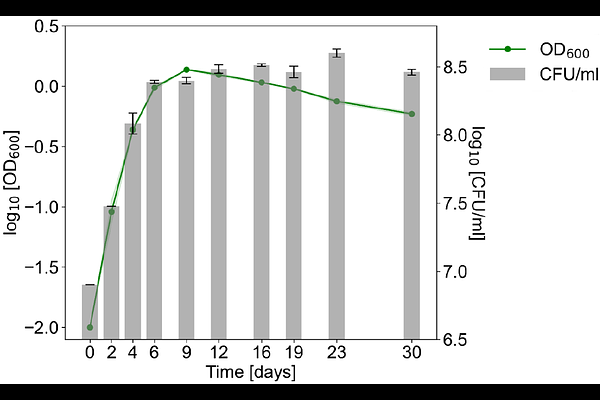
AbstractHeterotrophic marine bacteria frequently experience fluctuations in carbon availability driven by phytoplankton dynamics. As a result, bacteria undergo repeated cycles of rapid growth during brief resource pulses followed by prolonged starvation. Yet the mechanisms that support bacterial survival during nutrient limitation remain poorly understood. Here, we investigate starvation survival in the algal-associated bacterium Phaeobacter inhibens. We show that cells remain viable for extended periods under carbon depletion while undergoing physiological and morphological changes. Using electron microscopy, metabolomics, and genetic approaches, we identify intracellular polyhydroxybutyrate (PHB) granules as a key factor supporting survival during starvation. PHB accumulates during growth and is progressively consumed under carbon limitation. Deletion of the PHB synthase gene (phaC) eliminates granule formation and reduces long-term viability. Comparative analyses show that the genetic capacity for PHB biosynthesis is widespread among members of the Roseobacter group, suggesting a conserved strategy among algal-associated bacteria. However, species lacking PHB also survive starvation, indicating that additional mechanisms contribute to persistence under nutrient limitation. Together, our results identify intracellular carbon storage as a central mechanism linking bacterial physiology to survival in fluctuating marine environments, and highlight the diversity of strategies shaping microbial community dynamics and carbon cycling in the ocean.