Interpersonal physiological synchrony: estimation and clinical application to cardiac dynamics of parent-infant dyads

Interpersonal physiological synchrony: estimation and clinical application to cardiac dynamics of parent-infant dyads
Lavezzo, L.; Grandjean, D.; Delplanque, S.; Barcos-Munoz, F.; Borradori-Tolsa, C.; Scilingo, E. P.; Filippa, M.; Nardelli, M.
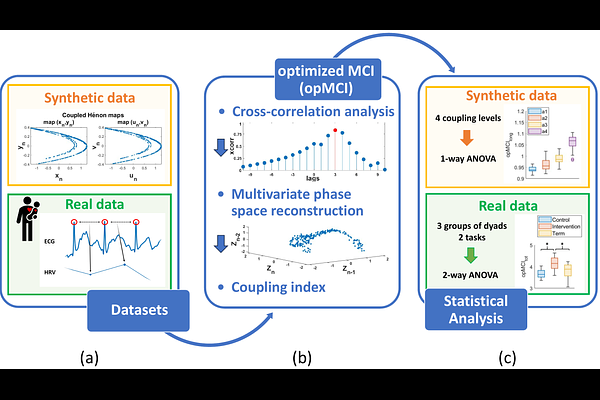
AbstractSynchrony is a key mechanism that builds up the foundations of human interactions. Quantifying the level of physiological synchronization that occurs during dyadic exchanges is essential to fully comprehend social phenomena. We present a new index to characterize the coupling of complex physiological dynamics: the optimized Multichannel Complexity Index (opMCI). We validated this approach using synthetic time series of two coupled Henon Maps, with four different coupling levels in unidirectional and bidirectional manners. We demonstrated that the opMCI method allows to effectively discern between all coupling levels. Then, we applied the opMCI metric on heart rate variability data collected from 37 parent-infant dyads, during shared reading and playing activities, in the framework of the Shared Emotional Reading (SHER) project, with the aim of assessing the effects of early intervention in preterm babies. Two groups presented preterm infants: an intervention group, who participated in a two-month shared reading program, and a control group, who practiced shared play activities. A full-term group provided additional control data. The opMCI values were significantly higher for the intervention dyads with respect to the other groups during the shared reading task, showing that an early reading intervention program could increase parent-infant synchrony in preterm babies.