Environmental Correlates for Anticoagulant Resistance in house mice Mus musculus

Environmental Correlates for Anticoagulant Resistance in house mice Mus musculus
Richardson, L. F.; Balsara, M.; Larose, C.; Cullingham, C. I.; Schulte-Hostedde, A.
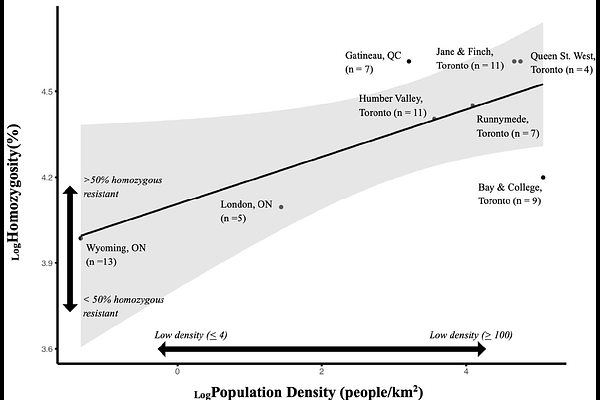
AbstractGenetic resistance to anticoagulant rodenticides is a world-wide evolutionary phenomenon among invasive commensal rodents, that has not been investigated in Canada. We sequenced exon 3 of the VKORC1 gene of house mouse Mus musculus samples obtained from pest management professionals in Ontario and Quebec, to search for mutations known to confer resistance. Sanger sequencing was used alongside a novel qPCR assay for codons 128 and 139. We detected high prevalence (99%) of two non-synonymous single nucleotide polymorphisms in house mice, previously found in the USA and Europe, known to cause extreme resistance to first and some second-generation anticoagulants (L128S & Y139C). Homozygous resistant mice were more common in high population density areas. L128S alleles were more common in Southwestern Ontario, and Y139C in Central Ontario, despite high linkage disequilibrium. Detection success was far greater with qPCR than with Sanger sequencing. We conclude that uncoordinated rodenticide usage has selected for extreme resistance in mice throughout Ontario. Therefore, chemical control of the house mouse may be ineffective with first-generation anticoagulants throughout Ontario. This suggests that the evolution of wild urban mice is influenced by pest management practices, which may vary by region within the province.