Pretend Comprehension Enhances Social and Exploratory Behaviors in Human Toddlers and Adults.

Pretend Comprehension Enhances Social and Exploratory Behaviors in Human Toddlers and Adults.
Gouet, C.; Jara, C.; Moenne, C.; Collao, D.; Pena, M.
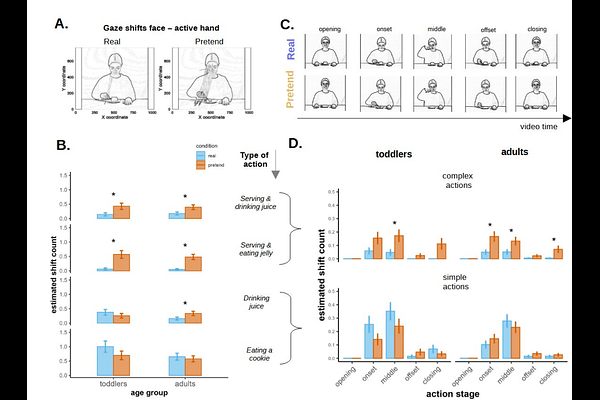
AbstractPretend play is a hallmark behavior in childhood where children create nonliteral meanings. Empirical data supporting the role of social cognition and the decoupling from literality are still scarce during early development. We explored here how the comprehension of pretense affects the visual exploratory behavior of toddlers (n = 44) and adults (n = 65) when they were exposed to short video clips in which an actress performed either real actions (e.g., eating jelly) or pretend actions (e.g., pretending to eat with imaginary food), while varying the complexity of those actions. We analyzed participants' exploration of the face in the videos as exploitation of social information. We showed that all observers paid more attention to the face in pretend scenarios than in real ones, measured as longer total looking time in adults and more fixations and revisits to the face in both age groups. We also found more gaze shifts (a measure of information sampling) between the face and the moving hand in the pretend videos in both age groups, mainly at the initial stages of the actions. Additionally, analyses of the scanpaths' structure using gaze entropy showed less order in the exploration of pretend videos in both age groups, suggesting that pretense involved greater uncertainty and increased information seeking. The less structured trajectories were observed again mainly in complex pretend scenarios. Taken together, our gaze results indicate that from its developmental origins, the comprehension of pretense relies on social processes linked with information seeking and exploration.