Spatial transcriptomic programs relate to spectrolaminar rhythms across macaque cortex

Spatial transcriptomic programs relate to spectrolaminar rhythms across macaque cortex
Reyes, R. G.; Vezoli, J.; Valdes-Sosa, P. A.
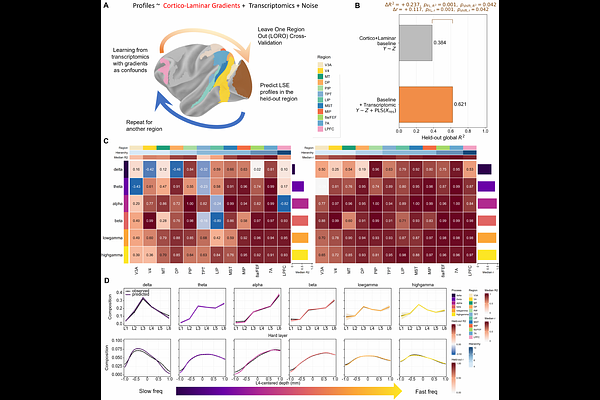
AbstractThe laminar organization of cortical dynamics is thought to reflect underlying cell-type architecture, but this relationship has not been resolved across primate cortex. Here we developed a spectro-omic framework that allows laminar local field potentials and single-cell spatial transcriptomics to be compared within a common layer-4-referenced coordinate system. Instead of relying on raw band-power analysis, we used Local Spectral Expansion (LSE), a spectrolaminar component model that resolves frequency-by-depth LFP power maps into distinct {delta}, {theta}, , {beta}, low-{gamma} and high-{gamma} components. We then introduced layer-4 projection (L4P) to unfold nonlinear spatial transcriptomic cortical ribbons into flat layer-4-referenced manifolds compatible with the electrophysiological depth profiles. Across twelve matched macaque cortical regions, transcriptomic predictors improved held-out prediction of LSE-derived six-anatomical-layer spectral composition beyond a hierarchy-plus-layer baseline in a partwise logit model: R2 = 0.621 versus 0.384; {Delta}R2 = +0.237; r = 0.809 versus 0.692. This gain was supported by hierarchy-preserving shift/reflect nulls (pshift,R2 = pshift,r = 0.042) and by a Freedman-Lane region-block residual-permutation test (pFL,R2 = pFL,r = 0.001). Full-depth PLS1 decoding linked /{beta} processes to deep-layer, especially L4/5/6 and L6, glutamatergic programs enriched for axonal, synaptic and myelin-associated biology, whereas low-{gamma} and high-{gamma} processes were linked to superficial-to-middle-layer GABAergic/PVALB-enriched inhibitory programs together with excitability, ion-homeostasis, non-neuronal and energy-metabolism signatures. Together, these observed spectro-omic relationships suggest that laminar molecular and cellular architecture forms a plausible substrate for the spectrolaminar motif across macaque cortex.