The Best Guess: Testing new and old formalisms for the common envelope against observations

The Best Guess: Testing new and old formalisms for the common envelope against observations
Riley Thai, Amanda Karakas, Zara Osborn, Robert Izzard, Ryosuke Hirai, Alex Kemp, Simon Campbell
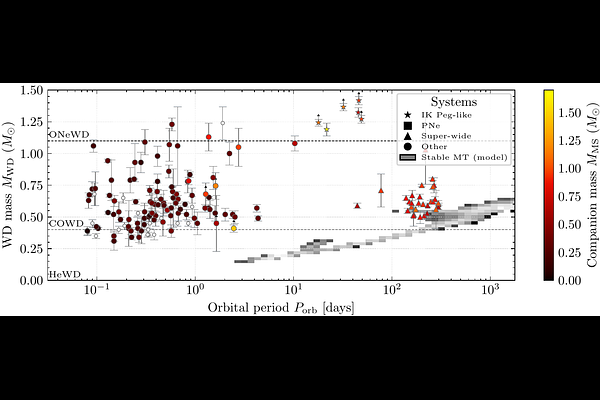
AbstractWe present a systematic test of formalisms for common envelope evolution by forward-modelling observable post-common envelope binaries. We compare predictions from the $α$-formalism, and the Two-stage and SCATTER formalisms against observed post-common envelope binaries, including wide binaries with ultra-massive white dwarfs and central binaries of planetary nebulae. The angular momentum-based SCATTER formalism does not predict populations which match the complete observed population, even with adjustments to its parameters. We take this as indicative of fundamental challenges with using the orbital angular momentum balance to predict common envelope outcomes. The energy-based $α$ and hybrid Two-stage formalisms both well-replicate the observed population. $α_{\rm CE} \sim 0.2\text{--}0.3$ can match current observations, in agreement with previous works. Recombination energy is necessary, but only a fraction of it ($\sim\! 10\text{--}40\%$) can contribute in order to predict IK Peg-like binaries with ultra-massive white dwarfs at the correct orbital periods. Our work suggests energy-based formalisms remain the most accurate for predicting common envelope outcomes, but more observations can constrain the recombination contribution and how these outcomes systematically vary with the donor mass.