Using Cryogenic Electron Tomography (cryoET) to Determine Rubisco Polymerization Constants in α-Carboxysomes

Using Cryogenic Electron Tomography (cryoET) to Determine Rubisco Polymerization Constants in α-Carboxysomes
Cao, W.; Rochon, K.; Gray, R. H.; Oltrogge, L. M.; Savage, D.; De La Cruz, E.; Metskas, L. A.
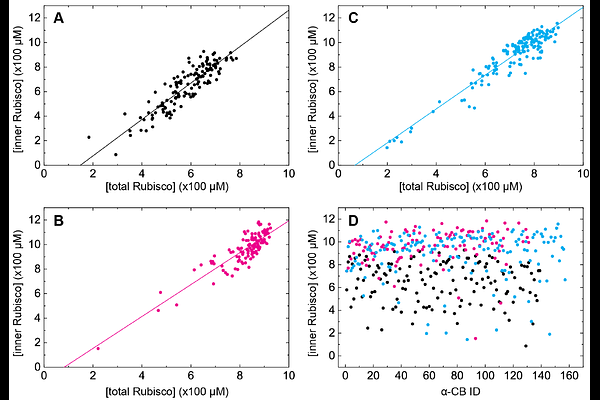
AbstractBacteria microcompartments (BMCs) are pseudo-organelles comprised of a self-assembling, semi-permeable protein shell, most commonly enclosing components of enzymatic pathways. -Carboxysomes (-CBs) are anabolic BMCs known for their role in sequestering Rubisco, the enzyme responsible for carbon fixation in plants, algae and bacteria, along with an upstream enzyme and an assembly protein. Rubisco has low selectivity for its substrate, CO2, and has a slow enzymatic turnover rate, resulting in an inefficient metabolic pathway. Within the -CB, Rubisco has been observed at a range of concentrations and with either a liquid-like assembly or a pseudo-lattice of polymerized fibrils. The biophysical origins of the fibril ultrastructure organization are unclear; however, it is only observed inside -CBs. Quantitative knowledge of the binding constants and energies for assembly and maintenance of these fibrils is critical for understanding this organization and Rubisco regulation, but quantitative methods for in situ analysis of Rubisco polymerization have been lacking. Here, we present an approach to convert tomography-derived -CB volumes and Rubisco particle positions into polymerization binding curves. We used this procedure to determine the Rubisco polymerization constants, including the nucleus size (n) and equilibrium polymerization constant (Kpol). The adopted modeling approach is consistent with in situ constraints, such as concentration-dependent binding interactions and confinement. This approach offers a powerful tool to evaluate both in vitro and potentially in vivo biomolecular interactions, both of Rubisco and of other proteins and polymers suitable for analysis by cryo-electron tomography.