Massive star clusters detected by JWST as natural birth places to form intermediate-mass black holes

Massive star clusters detected by JWST as natural birth places to form intermediate-mass black holes
Dominik R. G. Schleicher, Matías Liempi, Mirek Giersz, Marcelo C. Vergara, Francesco Flammini Dotti, Paulo Solar, Andrés Escala, Muhammad A. Latif, Bastián Reinoso, Abbas Askar, Raffaella Schneider, Roberto Capuzzo-Dolcetta, Jorge Saavedra-Bastidas, Fernando Cuevas
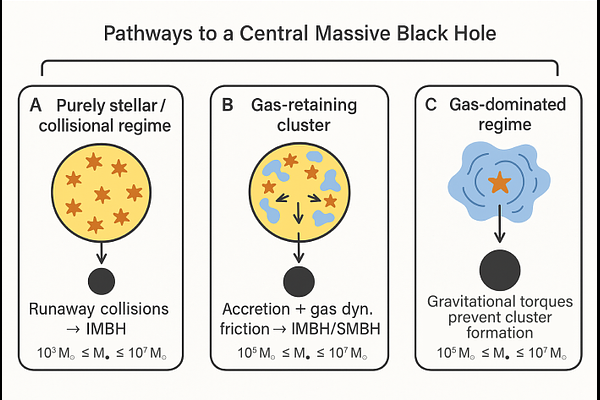
AbstractThe James Webb Space Telescope (JWST) has detected, through gravitational lensing, several young massive star clusters (YMCs), which are considered as relevant building blocks of high redshift galaxies. In this work, we show how a significant fraction of these YMCs could act as relevant birth places for intermediate-mass black holes. We first consider the formation of massive clusters and show that the population of YMCs is consistent with a steep mass-radius relation, which includes a relevant spread of roughly an order of magnitude. We pursue a comparison of this population with young star clusters in the local Universe and Milky Way globular clusters, including an analysis of the characteristic timescales. The YMCs show a wide spread over these properties, but include systems with both short relaxation times as well as relatively short collision timescales, implying they could go through efficient core collapse, which would lead to runaway collisions. We provide quantitative estimates of the sizes of the clusters that could efficiently form intermediate-mass black holes through a runaway collision-based channel, suggesting that these roughly correspond to the systems beyond the $1σ$ scatter in the mass-radius relation. This implies a fraction of ~16% of YMCs as candidates to form intermediate-mass black holes. We show that above a mass limit of ~6x10^6 M_sun, compact star clusters are likely to retain gas even in the presence of strong supernova feedback, altering the dynamics in the central core and providing the possibility to rapidly grow the central object both via gas dynamical friction and Bondi accretion. Finally, we consider the possibility of a gas-dominated regime, in which strong gravitational torques may inhibit star cluster formation and instead directly form a high-mass black holes, as suggested to have occurred in the infinity galaxy.