Auditory attention reorganizes the phase alignment of neural oscillations

Auditory attention reorganizes the phase alignment of neural oscillations
Korisky, A.; Kaneshiro, B.; Gosavi, R. S.; Toomarian, E. Y.; Bunderson, M.; McCandliss, B.
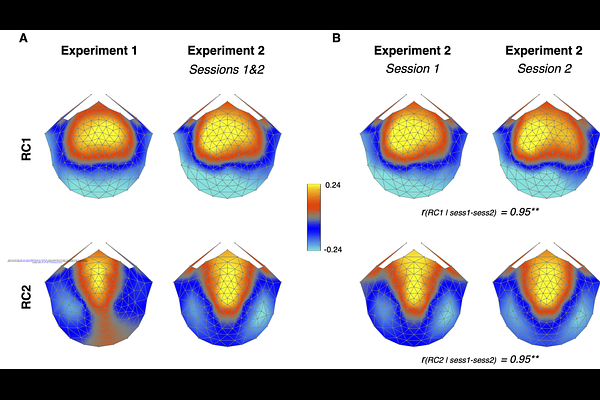
AbstractAuditory attention enables the selection of behaviorally relevant sounds in dynamic environments, supporting the flexible allocation of neural resources over time. Although neural entrainment has been proposed as a mechanism for temporal prediction in audition, human studies have largely emphasized changes in response strength, leaving unresolved whether attention reorganizes the temporal alignment of entrained activity across hierarchical cortical networks. Here, we introduce the Selective Temporal Alignment of Components (STAC) framework to dissociate stimulus-driven and attention-controlled dynamics using non-invasive EEG. In a series of experiments across two independent adolescent cohorts (n = 79), Reliable Components Analysis (RCA) revealed two dissociable entrained networks with distinct spatial, functional, and attentional profiles: a sensory-driven network that remained tightly stimulus-locked and a frontal-auditory network that exhibited systematic attention-dependent phase shifts. These phase dynamics were consistent across independent cohorts and stable within individuals, and critically, predicted performance on a standardized neuropsychological measure of auditory attention. Together, these findings establish selective temporal alignment as a robust and behaviorally relevant neural mechanism underlying auditory attentional control.