Constraints on the population level distribution of nearby Dark Matter halo shapes with extragalactic streams

Constraints on the population level distribution of nearby Dark Matter halo shapes with extragalactic streams
David Chemaly, Elisabeth Sola, Sergey Koposov, HanYuan Zhang, Vasily Belokurov, Denis Erkal
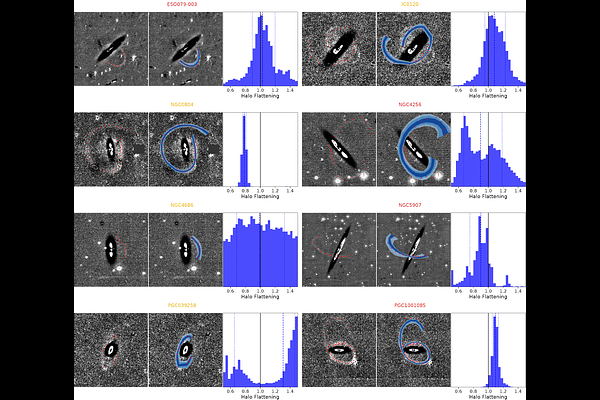
AbstractStellar streams trace the gravitational potential of their host galaxies and provide a sensitive probe of dark matter halo structure. Previously, we developed, and tested on simulated data, a hierarchical Bayesian framework to infer the population level distribution of dark matter halo shapes from ensembles of extragalactic stellar streams with images only. In this work, we apply this pipeline to 32 stellar streams from the STRRINGS catalogue, a curated sample of dynamically cold minor-merger streams detected in deep imaging. Each stream is forward-modelled assuming an axisymmetric halo and fitted using only the projected stream track, yielding posterior constraints on the halo flattening parameter $q$. To account for model mismatch and track systematics, we introduce an additional variance term that inflates the uncertainty on the projected stream track and use it to identify a high quality (gold) subsample of 17 streams whose tracks retain significant constraining power. We then combine the individual posteriors through importance sampling to infer the underlying population distribution of halo flattening. For the \textit{gold} subsample, we infer an oblate population with mean $μ_q \approx 0.72$ and intrinsic scatter $σ_q \approx 0.34$. Streams dominated by additional model variance yield a nearly spherical population inference. The inferred oblate population for the gold sample is broadly consistent with expectations from cosmological hydrodynamical simulations. This work provides constraints on dark matter halo flattening from stellar streams beyond the Local Group and establishes a scalable framework for forthcoming large samples from Euclid and Rubin/LSST.