Early electrical stimulation promotes functional recovery after volumetric muscle loss

Early electrical stimulation promotes functional recovery after volumetric muscle loss
Gershanok, S.; Behre, A.; Jin, R.; Vinokurova, S.; Blount, J.; Garg, R.; Ersoz, A.; Wang, L.; Jo, S.; Ranke, D.; Kulkarni, M.; Cohen-Karni, D.; Feinberg, A. W.; Weber, D.; Brown, B.; Cohen-Karni, T.
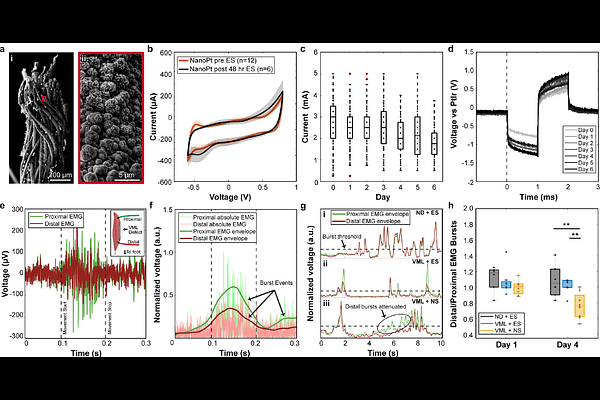
AbstractVolumetric muscle loss (VML) injuries overwhelm the inherent regenerative capacity of skeletal muscle, causing persistent functional deficits with no routinely effective therapies. Electrical stimulation (ES) has been shown to preserve muscle structure in other injury models, but technical barriers have prevented daily delivery during the acute post-injury window when critical regenerative programs are established. Here, we developed a fully implantable bioelectronic system with nanoporous platinum-modified electrodes enabling daily therapeutic stimulation and electromyographic recording without repeated anesthesia in a rat tibialis anterior VML model. Animals receiving ES during the acute post-injury period (10 sessions over days 0-4) showed sustained functional improvement, reaching 86.5% of baseline torque at 8 weeks compared to 68.1% in unstimulated controls. This recovery reflected enhanced remodeling of injured muscle rather than synergistic muscle compensation. Histological analysis revealed coordinated early increases in vascularization, pro-regenerative macrophages, and satellite cells. These findings establish early ES as a promising intervention for promoting muscle regeneration after catastrophic injury.