From Fabrication to Flow: Impact of Print Orientation on Surface Qualities and Capillary-Driven Flow in Laser SLA-based Open Microchannels

From Fabrication to Flow: Impact of Print Orientation on Surface Qualities and Capillary-Driven Flow in Laser SLA-based Open Microchannels
Lin, A.; Milton, L.; Chan, D. W. H.; Ghadge, N.; Tokihiro, J.; Brown, L.; Shin, A.; Toh, Y.-C.; Olanrewaju, A.; Berthier, E.; Berthier, J.; Theberge, A.
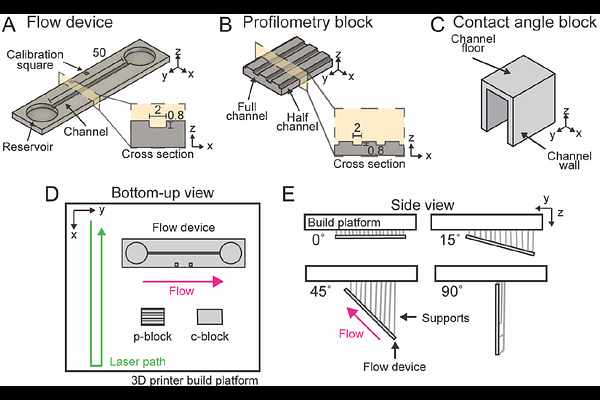
AbstractStereolithography (SLA) 3D printing has become increasingly popular for fabricating microfluidic devices, with applications including hydrogel patterning and tissue modeling. In open-channel systems with surface tension-driven flow, 3D-printer-induced discrepancies in channel surface texture can significantly impact fluid flow and device performance. While previous work has focused on comparing different 3D printing methods for microchannel fabrication, the effect of device orientation during SLA printing on microchannel morphology and capillary-driven flow has not been systematically evaluated. Furthermore, there is minimal research elucidating the influence of channel surface texture on the flow of biologically relevant hydrogel precursors commonly used in organ-on-a-chip applications. Herein, we investigated the impact of print orientation on channel morphology, fluid wetting behavior, and fluid flow by comparing laser SLA-based parts where the length of the channel was tilted at 0{ring}, 15{ring}, 45{ring}, or 90{ring} during printing. We demonstrated that channel floor surface texture is greatly affected by print orientation: the highest axial surface roughness was measured in 15{ring} printed channels, and the highest axial surface tortuosity--which describes the real length along the surface--was measured in 45{ring} printed channels. Print angles of 15{ring} and 45{ring} also resulted in asymmetric roughness of the channel floor, which caused asymmetric wetting of glycerol solution. Surface tension-driven flow of glycerol solution, agarose precursor solution, and collagen precursor solution was affected by print orientation, in which the 45{ring} printed flow devices had slowest flow for all test fluids. Root mean square roughness was not a reliable predictor of slower flow; instead, surface tortuosity should be considered. Potential alternatives to better theoretically model how print angle-induced surface texture affects open-channel flow are discussed as well. These findings provide a framework of fabrication considerations for laser SLA printing of open microchannels that can also be applied to other layer-by-layer, vat photopolymerization-based 3D printing technologies.