Functional ultrasound imaging through a human cranial window for mesoscopic mapping of motor effector encoding within the sensorimotor cortex

Functional ultrasound imaging through a human cranial window for mesoscopic mapping of motor effector encoding within the sensorimotor cortex
Lin, L. J.; Callier, T.; Heiles, B.; Pejsa, K.; Liu, C. Y.; Shapiro, M. G.; Andersen, R. A.
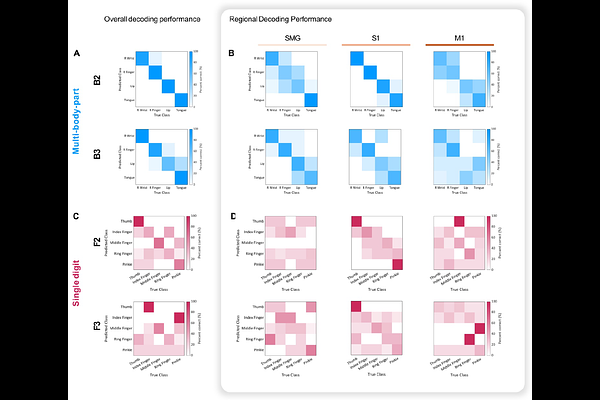
AbstractUnderstanding movement encoding within human cortical circuits has been essential for advancing brain computer interfaces (BCIs). However, there are limited minimally invasive, high resolution neurorecording methods sensitive enough to detect single-trial movement-correlated neural activity. Functional ultrasound imaging (fUSI) provides submillimeter spatial resolution of deep cortical tissue with high sensitivity and, when paired with acoustically transparent skull implants, enables transcutaneous recording of human neurovascular changes. Prior studies have used fUSI in participants with acoustically transparent skull implants for on-off task mapping and decoding. Here, we demonstrate fUSI's ability to reliably resolve multi-body-part and single digit movement encoding within the primary sensorimotor cortex in a participant with an acoustically transparent skull implant. We obtained fine-grained mappings of individual effector representation that were consistent with classic somatotopy for both multi-body-part and single digit movement. We were able to resolve single-trial event-related activity, enabling single-trial decoding of both conditions. Analysis of voxels important for decoding suggested differential encoding of single digit movement information across the different Brodmann areas. Finally, we show that these patterns can be approximated across different sessions, allowing for cross session decoding. These results establish that fUSI can reliably delineate somatotopically organized motor representations at submillimeter resolution, bridging a critical gap between invasive electrophysiology and noninvasive hemodynamic imaging in a human subject.