APOE4 Genotype is Associated with Reduced Cortical VEGFR2 (KDR) Transcript Levels Independent of Endothelial Abundance: An AMP-AD RNA-seq Pilot Study

APOE4 Genotype is Associated with Reduced Cortical VEGFR2 (KDR) Transcript Levels Independent of Endothelial Abundance: An AMP-AD RNA-seq Pilot Study
Laing, K.; Montagne, A.
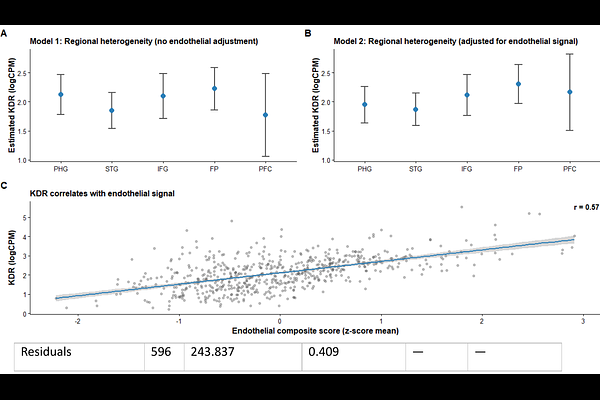
AbstractBACKGROUND: Apolipoprotein E4 (APOE4) is the strongest common genetic risk factor for late-onset Alzheimers disease and has been implicated in cerebrovascular dysfunction. Vascular endothelial growth factor receptor 2 (VEGFR2), encoded by the gene KDR, is a key regulator of endothelial integrity and blood brain barrier (BBB) maintenance; however, its relationship to APOE4 status in human brain tissue remains unclear. METHODS: Bulk RNA-sequencing data from 162 donors (n = 633 cortical samples) from the AMP-AD MSSB cohort were analysed using linear mixed-effects models with donor-level random intercepts. Models were adjusted for tissue region, age at death, sex, RNA integrity (RIN), and post-mortem interval. An endothelial composite score derived from key endothelial markers (PECAM1, VWF, CLDN5, FLT1, TEK) was included to account for endothelial signal abundance. Interaction models assessed modification by cortical region and neuropathological burden (Braak stage, CERAD score, plaque mean). A candidate panel of endothelial/BBB transcripts (KDR, CAV1, MFSD2A, CLDN5, SLC2A1, OCLN, TJP1) were also assessed in relation to APOE genotype. RESULTS: Bulk KDR expression varied significantly across cortical regions (p < 2x10-16) and was strongly correlated with endothelial signal abundance (r = 0.57, p < 2x10-16). APOE4 status was not associated with endothelial composite score (p = 0.78). In models adjusting for tissue and technical covariates, but not endothelial signal, APOE4 carriers showed a non-significant trend toward reduced KDR expression ({beta} = -0.16, p = 0.064). After inclusion of the endothelial composite score, APOE4 carrier status was significantly associated with reduced KDR expression ({beta}-0.17, p = 0.029), corresponding to an estimated 10-15% decrease in transcript levels. The direction of effect was consistent across cortical regions, with no evidence of APOE4 x region interaction. No significant APOE4 x neuropathology interactions were observed. Among candidate transcripts, only KDR and TJP1 showed reduced expression, suggesting a selective rather than global transcriptional effect. CONCLUSIONS: Bulk KDR transcript levels are strongly influenced by endothelial signal abundance; however, APOE4 is associated with a modest but consistent reduction in VEGFR2 expression independent of endothelial signal abundance and neuropathological severity. These findings support a model in which APOE4 contributes to vascular dysfunction through targeted endothelial alterations, rather than merely reflecting changes in endothelial cell proportion.