How I Wonder What You Are -- JWST's Little Red Dots do not TWINKLE

How I Wonder What You Are -- JWST's Little Red Dots do not TWINKLE
Zhaoran Liu, Rohan P. Naidu, Amy Secunda, Jenny E. Greene, Jorryt Matthee, John Chisholm, Anna de Graaff, Luke Robbins, Jacqueline Antwi-Danso, Gabriel Brammer, Wendy Q. Sun, Anna-Christina Eilers, Seiji Fujimoto, Lukas J. Furtak, Erin Kara, Vasily Kokorev, Danilo Marchesini, Pascal A. Oesch, Justin D. R. Pierel, Xuejian Shen, Robert A. Simcoe, Alberto Torralba, Mark Vogelsberger
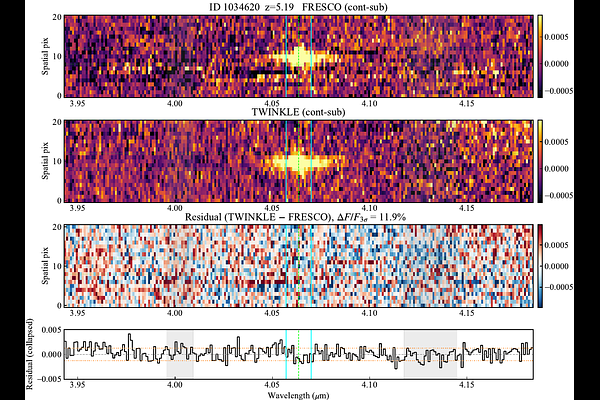
AbstractLittle Red Dots (LRDs) are a population of compact, red sources that have emerged as one of the most puzzling findings of JWST. Variability provides a direct probe of their central engines. Here we present the first joint spectroscopic and photometric time-domain study of LRDs undertaken with the JWST TWINKLE slitless spectroscopy program. Surveying the FRESCO GOODS-North legacy field, TWINKLE monitors a complete, H$α$-flux-limited sample of 18 LRDs at z = 3.9-6.8, achieving a rest-frame baseline of $\sim$140-220 days. We detect no variability in photometry, H$α$ line flux, or line shape across the sample. If LRDs resembled AGN in reverberation mapping samples -- the foundation for black hole mass calibrations and luminosity scaling relations -- we would expect >10 sources to show measurable fluctuations. Observing none implies a 5.9$σ$ deficit. The non-detections hold across all broad H$α$ emitters within TWINKLE's field of view -- the 18 V-shaped LRDs as well as 9 non-LRDs. Comparison with simulated light curves disfavors sub-Eddington accretion and is instead consistent with super-Eddington accretion, other mechanisms that suppress variability, or perhaps no AGN whatsoever. If LRDs do harbor black holes, calibrations derived from sub-Eddington systems may not apply, thereby explaining JWST's apparently "overmassive" black holes. These observations provide unique constraints on the physics of one of the most enigmatic populations discovered by JWST.