Good parenting of oil-collecting bees: microbial defense in nests of Centris bees?

Good parenting of oil-collecting bees: microbial defense in nests of Centris bees?
Kardas, E.; Pacheco-Leiva, M.; Artavia-Leon, A.; Fernandez Otarola, M.; Vargas Asensio, G.; Pinto-Tomas, A. A.; Godoy-Vitorino, F.
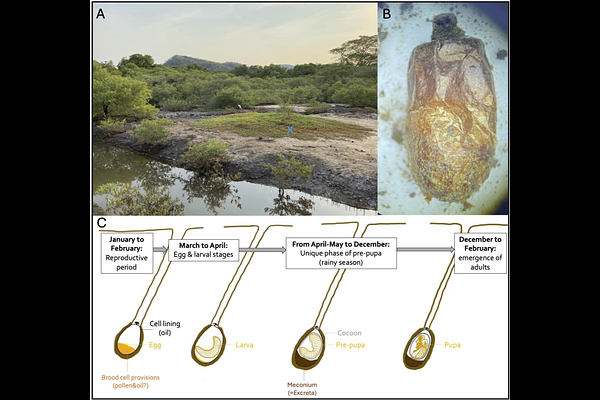
AbstractMicrobial symbionts are increasingly recognized as key contributors to bee health, yet their roles in solitary bee brood cells remain largely unexplored. Here, we characterize the bacterial and fungal communities associated with brood cell compartments (cocoon, meconium, and pre-pupa) of the oil-collecting bee Centris aethyctera, and compare them with gut microbiota from adult Centris species. Using 16S rRNA and ITS amplicon sequencing, we show that microbiota are strongly compartmentalized, with distinct diversity patterns, taxonomic compositions, and inferred functional profiles across brood cell components. Contrary to our initial hypothesis, antibiotic-producing bacteria, particularly Actinomycetia, are most diverse and abundant in the meconium rather than the cocoon. Cocoons are enriched in hydrocarbon-degrading and nitrogen-cycling bacteria, while pre-pupae harbor distinct bacterial and fungal taxa, including genera with potential antimicrobial and symbiotic functions. Fungal communities are likewise structured, with taxa such as Aspergillus and Lecanicillium suggesting possible roles in pathogen defense. Core gut microbiota of adult Centris include acetic acid bacteria shared across species, with partial overlap with brood cell taxa, indicating potential transmission pathways. Together, our results reveal that Centris brood cells form a highly structured, antimicrobial-rich microenvironment likely shaped by maternal provisioning and environmental acquisition. These findings provide the first comprehensive description of microbiota across brood cell compartments in a solitary bee and identify ground-nesting bee systems as promising reservoirs for novel antimicrobial discovery.