Molecular mechanics of smooth muscle contraction and relaxation modulated by caldesmon

Molecular mechanics of smooth muscle contraction and relaxation modulated by caldesmon
Schultz, M. L. C.; Kachmar, L.; Liu, C.; Bai, A.; Fletcher, S.; Lauzon, A.-M.
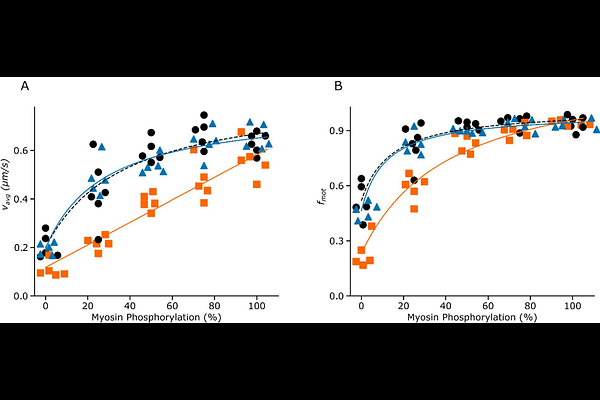
AbstractSmooth muscle (SM) contraction is well known to be regulated by the reversible phosphorylation of the myosin regulatory light chain. However, SM force generation and relaxation are often uncoupled from myosin phosphorylation levels (e.g. the latch-state), indicating that additional regulatory mechanisms must be at play. The precise effects of the actin binding protein caldesmon (CaD) on SM force production and relaxation remain ambiguous, largely due to contradictory findings in experiments performed at the tissue level. To date, there are no studies that have measured the effects of CaD on force and relaxation at the molecular level. Here, we use a laser-trap assay to measure the force produced by SM myosin molecules in the presence and absence of CaD. Measurements were performed before and during myosin dephosphorylation, thus simulating SM contraction and relaxation in-vitro. We demonstrate that CaD inhibits force generation, most likely through competitive inhibition of actomyosin binding while simultaneously introducing a resistive load via tethering of actin and myosin. We also establish CaD as a potentiator of relaxation, increasing force decay rate during myosin dephosphorylation. Finally, we show that CaD directly modulates the dependence of myosin-actin mechanics on myosin phosphorylation levels. These findings refine our understanding of SM regulation, highlighting CaD not merely as a passive structural stabilizer, but as a critical regulatory component of force development and relaxation. Ultimately, understanding these mechanical functions offers new perspectives on pathophysiologies involving SM, such as asthma, hypertension, and gastrointestinal disorders, potentially guiding targeted therapeutic strategies.