Microtubule binding protein Togaram1 is required for proper development of mammalian forebrain and neural primary cilia

Microtubule binding protein Togaram1 is required for proper development of mammalian forebrain and neural primary cilia
Nassar, C. Q.; Shetty, S. J.; Dwyer, N. D.
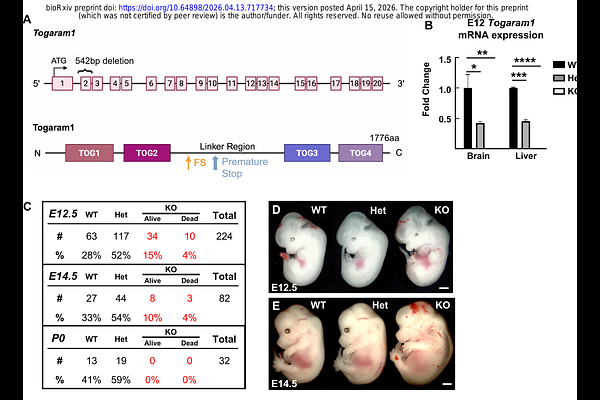
AbstractProper forebrain development relies on precise spatial and temporal control of early neural stem cell (NSC) proliferation and later neurogenesis. Brain malformations can arise when these processes are defective. Joubert Syndrome (JS) is a neurodevelopmental disorder that is diagnosed by a mid-hindbrain malformation, but often includes forebrain defects such as microcephaly, which are less understood. One gene recently linked to Joubert Syndrome with microcephaly is Togaram1, which encodes a TOG domain microtubule binding protein shown to affect primary cilia. In the embryonic dorsal forebrain, NSCs have primary cilia on their apical membranes that play a role in regulating proliferation and neurogenesis, but how they do this is not well understood. Here we investigate the role of Togaram1 in mammalian forebrain development using a mouse knockout. We find that Togaram1 is crucial for forebrain size, thickness, and morphology. In particular, knockout forebrains have sporadic indentations of the lateral ventricles, and the neuronal layer is thin with gaps and heterotopias. The dorsal forebrain NSCs have increased proliferation and apoptosis. Finally, the primary cilia of Togaram1 knockout NSCs have abnormal morphology and function. This study begins to elucidate the role of Togaram1 in forebrain morphogenesis and the involvement of NSC primary cilia in forebrain malformations.