Turning Galaxy Rotation Curves into Radial Cosmic Chronometers: A Nexus Paradigm Approach

Turning Galaxy Rotation Curves into Radial Cosmic Chronometers: A Nexus Paradigm Approach
Stuart Marongwe, Stuart A. Kauffman
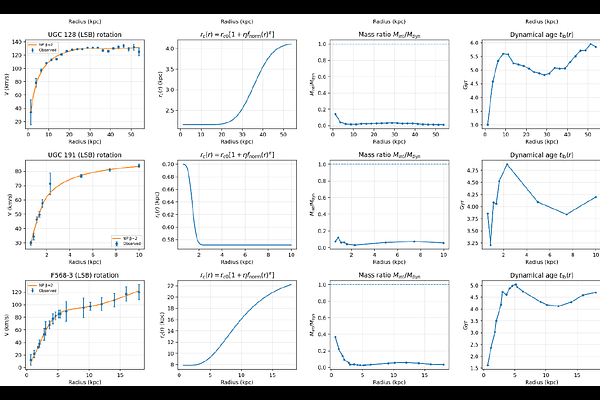
AbstractWe present a method for transforming galaxy rotation curves into radially resolved dynamical chronometers, enabling reconstruction of galaxy assembly histories directly from kinematic data. Within the Nexus Paradigm, the baryonic Tully-Fisher relation provides an estimate of the dynamical mass profile $ M_{dyn}(r)=v^4/Ga_0$, where $a_0=H_0/2π$.By Comparing this with independently derived intrinsic baryonic mass profiles, $M_{int}(r)$, obtained from stellar Sérsic fits and gas surface density measurements, we construct the ratio $ M_{dyn}(r)/M_{int}(r)$, which maps directly to a formation redshift via $ 1+z_{form}(r)=(M_{dyn}/M_{int})^{1/4}$. Inverting this relation with$ΛCDM$ cosmology yields a radial lookback-time profile, $t_{lb}(r)$, representing the time since the last dynamical reconfiguration at each radius. Applying this framework to a pilot sample of SPARC galaxies spanning high-and low -surface-brightness systems, together with the Milky Way, we recover diverse radial age structures, including flat profiles consistent with coherent disk assembly and stratified profiles indicative of inside-out growth. The method operates without dark-matter halo fitting and provides a kinematic chronometer complementary to stellar-population and chemical-evolution approaches. While the inferred ages depend on the accuracy of baryonic mass reconstruction and local applicability of the evolving baryonic Tully-Fisher relation, the results demonstrate that galaxy rotation curves encode time-resolved dynamical information. This establishes the radial dynamical chronometer as a new observable for probing galaxy evolution and testing gravitational frameworks.