Expanding Microgel Parameters to Model the Tumor Microenvironment and Examine Temozolomide Resistance in Glioblastoma

Expanding Microgel Parameters to Model the Tumor Microenvironment and Examine Temozolomide Resistance in Glioblastoma
Payan, B. A.; Kattoor, J.; Carrillo Diaz De Leon, A.; Thompson, G.; Molley, T.; Kilian, K.; Sarkaria, J. N.; Harley, B.
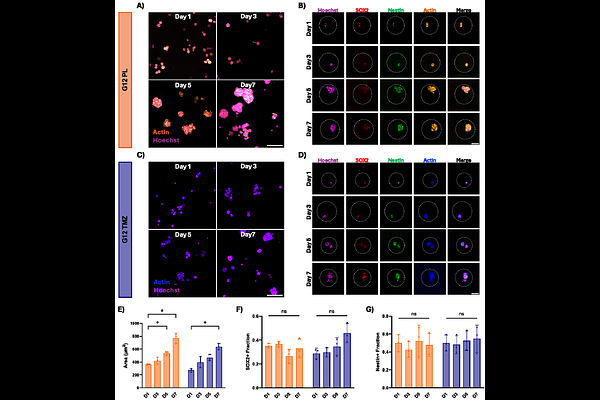
AbstractGlioblastoma (GBM) is a highly aggressive brain tumor with a five-year survival rate of less than 5%. The current standard of care established 20 years ago includes maximal surgical resection and administration of alkylating agent temozolomide (TMZ). GBM is highly invasive, and GBM cells that evade surgical resection can become resistant to TMZ and develop new aggressive secondary tumors. Post-relapse there are few treatment options available to patients. Tissue engineering approaches suggest the opportunity to develop in vitro models of the GBM tumor microenvironment that may accelerate the discovery of novel therapies for GBM. Here, we report the adaptation of hydrogel microdroplets (microgels) to encapsulate GBM cells in a tailorable 3D matrix to assess patterns of growth and to screen TMZ drug response using patient-derived xenograft (PDX) specimens. We exploit a unique aspect of the microgel system to account for the cellular heterogeneity within the tumor microenvironment (TME). We combine cell-laden microgels generated from TMZ-resistant and TMZ responsive variants of the same PDX specimens to create heterogeneous populations with varying levels of drug sensitivity. We demonstrate a range of drug resistance phenotypes as a function of the ratio of TMZ-responsive to resistance cells and identify the population required for TMZ-resistance to overtake take the response. We then investigate the influence of tumor mimetic shifts in hyaluronic acid bioavailability and hypoxia on patterns of TMZ resistance. We show exposure to matrix-bound hyaluronan increases TMZ resistance and the glioma stem cell population in both cell variants. Lastly, we report an increase in TMZ sensitivity but divergent changes in the GSC subfraction for TMZ resistant vs responsive GBM in the presence of hypoxia. Together, we demonstrate the versatility of cell-laden microgel approach to replicate heterogenous tumor populations, model shifts in the tumor microenvironment, and rapidly screen therapeutic response.