Intense and extended CIII] emission suggests a strong outflow in JADES-GS-z14-0

Intense and extended CIII] emission suggests a strong outflow in JADES-GS-z14-0
Stefano Carniani, Peter Jakobsen, Giacomo Venturi, Francesco D'Eugenio, Tobias J. Looser, Joris Witstok, Christopher N. A. Willmer, Andrea Ferrara, Zihao Wu, Santiago Arribas, Andrew J. Bunker, Stéphane Charlot, Jacopo Chevallard, Mirko Curti, Emma Curtis-Lake, Daniel J. Eisenstein, Kevin Hainline, Jakob M. Helton, Zhiyuan Ji, Xihan Ji, Benjamin D. Johnson, Mahsa Kohandel, Nimisha Kumari, Roberto Maiolino, Andrea Pallottini, Eleonora Parlanti, Pablo G. Pérez-González, Marcia Rieke, Pierluigi Rinaldi, Brant Robertson, Jan Scholtz, Sandro Tacchella, Hannah Übler, Chris Willot
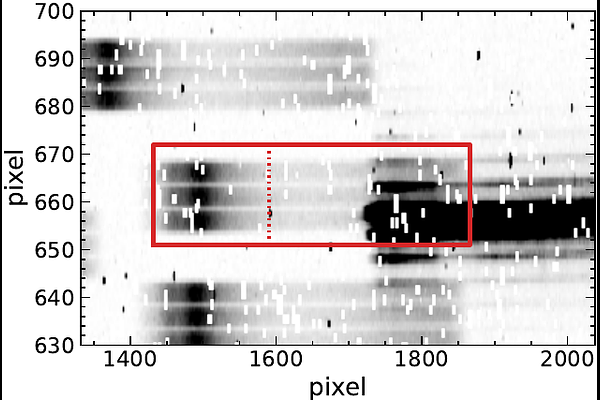
AbstractJWST has revealed an overabundance of very bright, blue galaxies at z>10, raising fundamental questions about how star formation and feedback operate at Cosmic Dawn. We present new JWST/NIRSpec MSA PRISM/CLEAR spectroscopy of JADES-GS-z14-0 (z=14.18) obtained with the JADES and OASIS programmes. While the rest-frame UV continuum flux level and shape are consistent between the two datasets, the OASIS spectrum shows a 10$σ$ detection of the CIII]$λ\lambda1907,1909$ emission line, with a luminosity three times higher than that measured in the JADES data. This difference is naturally explained by the offset in shutter placement between OASIS and JADES, implying that the CIII] emission is spatially displaced by $\sim400$ pc from the stellar continuum. The non-detection of CIII] in NIRCam medium-band imaging indicates that the emitting region is extended on scales $\gtrsim165$ pc, with a surface brightness below the detection threshold. Interpreting this diffuse, carbon-enriched gas as the result of ongoing or past outflows, we infer a mass outflow rate of $\dot{M}_{\rm out}\sim160~{\rm M_\odot\,yr^{-1}}$. We compare it with the star-formation rate (SFR) and derive a mass-loading factor of $η= \dot{M}_{\rm out}/{\rm SFR} = 4-15$, suggesting highly efficient feedback at very early times. Finally, we show that, if outflows are one of the mechanisms regulating star formation in JADES-GS-z14-0, the instantaneous star-formation efficiency in massive haloes is constrained to $ε_\star\lesssim0.08$. These results support a scenario in which outflows play a crucial role during the earliest phases of galaxy formation. Comparing our results with the current theoretical galaxy formation model, we conclude that a combination of moderate star-formation efficiency and reduced dust attenuation can account for the emergence of luminous galaxies at the highest redshifts.