Global genomic diversity of the selfing nematode Caenorhabditis tropicalis correlates with geography

Global genomic diversity of the selfing nematode Caenorhabditis tropicalis correlates with geography
Wang, B.; Moya, N. D.; Tanny, R. E.; Sauria, M. E. G.; O Connor, L. M.; Khorshidian, A.; McKeown, R.; Stevens, L.; Buchanan, C.; Crombie, T. A.; Dilks, C. M.; Evans, K. S.; Cook, D. E.; Zhang, G.; Stinson, L. A.; Roberto, N. M.; Lee, D.; Zdraljevic, S.; Gosse, C.; Gimond, C.; Chen, M.-E.; Dang, V. D.; Wang, J.; Cutter, A. D.; Rockman, M. V.; Felix, M.-A.; Braendle, C.; Andersen, E. C.
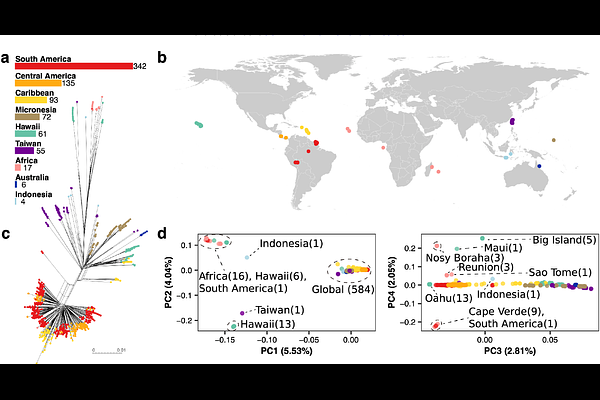
AbstractSelf-fertilization reduces genetic diversity compared to outcrossing and hypothetically decreases the ability to adapt to diverse environments. Among Caenorhabditis nematodes, self-fertilization evolved three times independently in Caenorhabditis elegans, Caenorhabditis briggsae, and the more recently discovered Caenorhabditis tropicalis. To survey C. tropicalis genetic relatedness, the influence of geography and niche on species-wide variation, and the signatures of selection, we collected 785 wild strains, sequenced their genomes, and identified 622 distinct genotypes (isotypes). In contrast to C. elegans and C. briggsae, C. tropicalis relatedness shows substantial association with geography and no transcontinental selective sweeps or broadly sampled isotypes. Populations from the Hawaiian Islands or Taiwan harbor more genetic variation than populations from the Caribbean or Americas, suggesting a Pacific species origin similar to other members of the Elegans subclade. Punctuated genomic regions of extreme genetic variation pervade the genome. These hyper-divergent regions (HDRs) comprise less than 6% of the reference genome in any given strain despite harboring 73% of all variant sites and are enriched for genes likely involved in environmental adaptation. HDRs represent a shared genomic feature of self-fertilizing Caenorhabditis nematodes despite their independent evolutionary origins and suggest a mechanism to explain worldwide distributions despite low species-wide levels of genetic variation.