Early interaction signatures and an extended plateau phase in Type II SN 2020aze

Early interaction signatures and an extended plateau phase in Type II SN 2020aze
B. Ailawadhi, R. Dastidar, K. Misra, S. Valenti, D. J. Sand, J. E. Andrews, J. P. Anderson, K. A. Bostroem, P. J. Brown, R. Cartier, T. W. Chen, Y. Dong, N. Dukiya, E. Padilla Gonzalez, M. Gromadzki, J. Haislip, D. Hiramatsu, D. A. Howell, C. Inserra, D. Janzen, S. W. Jha, V. Kouprianov, C. McCully, T. E. Müller-Bravo, C. Pellegrino, G. Pignata, D. E. Reichart, J. Sollerman, D. R. Young, L. Yadav
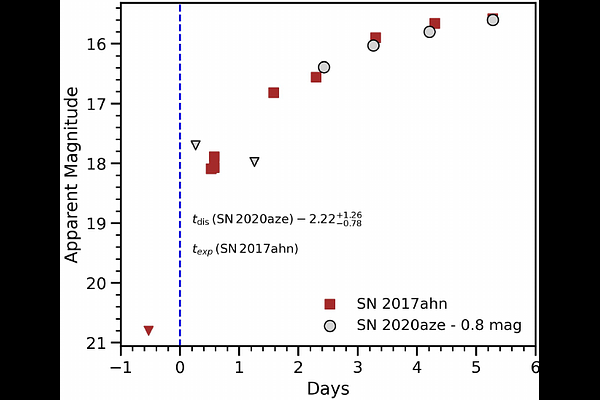
AbstractWe present a photometric and spectroscopic analysis of the fast-declining Type II SN 2020aze, observed in optical bands from 2.2 to 137.4 days after explosion. The V-band light curve reaches a peak absolute magnitude of about minus 16.97$\pm$0.20 mag by 15 days, followed by a recombination phase with a decline rate of 2.04$\pm$0.13 mag per 100 days, lasting about 120 days. Early spectra (younger than 6 days) show a transient weak narrow emission line at 4687 Angstroms and a feature spanning 4400-4800 Angstroms, attributed to narrow and broad blue-shifted He II 4686, indicating interaction between the ejecta and dense circumstellar material. Comparison with spectral models suggests a red supergiant progenitor with a weak wind and a mass-loss rate of about 1e-3 solar masses per year. Semi-analytical light-curve modeling gives an initial radius of about 1100 solar radii, an ejecta mass of about 12 solar masses, an explosion energy of about 1.5e51 erg, and a progenitor mass of about 14 solar masses. These early interaction signatures, the steep decline, and the extended photospheric phase highlight the role of pre-supernova mass loss and circumstellar interaction in shaping the diversity of Type II supernovae.