Anomalously Strong Localized First Ionization Potential Effect Associated with a Solar Subflare

Anomalously Strong Localized First Ionization Potential Effect Associated with a Solar Subflare
Man-Hei Ng, Xiaoping Zhang, P. F. Chen
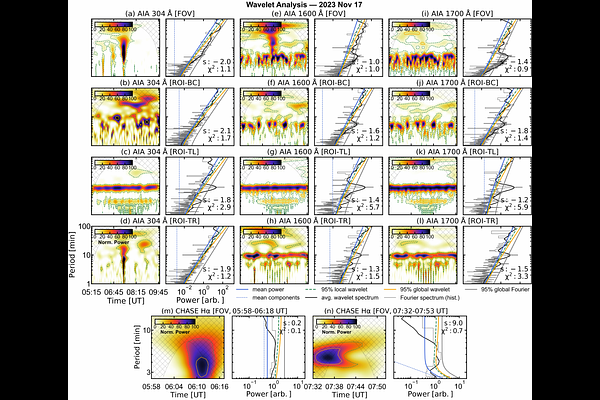
AbstractPlasma composition in the solar corona commonly differs from that of the photosphere, with the enhancement of low--first-ionization-potential (FIP) elements referred to as the FIP effect. This phenomenon provides important diagnostics of energy and mass transport between different layers of the solar atmosphere. In this work, we analyze an anomalously strong, localized FIP effect observed in active region 13486 associated with a subflaring episode on 2023 November 17, using multiwavelength observations combining high energy-resolution soft X-ray disk-integrated spectra obtained by the Macao Science Satellite-1B with spatially resolved EUV/UV and H$α$ imaging from Hinode/EIS, SDO/AIA and HMI, and CHASE/HIS. By investigating the temporal evolution of plasma composition in response to changes in magnetic field orientation, we provide new insight into the physical processes linking magnetic reconnection, ponderomotive force fractionation, and coronal abundance anomalies. This work reveals that the anomalously strong enhancement of low-FIP elements is localized in regions with strongly inclined magnetic fields despite a subflare. We interpret these observations within the framework of the ponderomotive force fractionation model and propose that the inclined magnetic geometry enhances the transmission of upward-propagating magnetohydrodynamic waves by reducing reflection near the plasma-$β$$\simeq$1 layer, enhancing FIP fractionation associated with a consequential upward-directed ponderomotive force. In addition, sustained chromospheric heating associated with chromospheric reconnection and flux cancellation appears to maintain the enhanced FIP effect for tens of minutes following the event.