Microtubule architecture and detyrosination bidirectionally modulate sarcomere shortening in skeletal muscle fibers

Microtubule architecture and detyrosination bidirectionally modulate sarcomere shortening in skeletal muscle fibers
Esen, O.; Larose, E.; Vonk, L. A.; ten Cate, N.; Kirby, T. J.
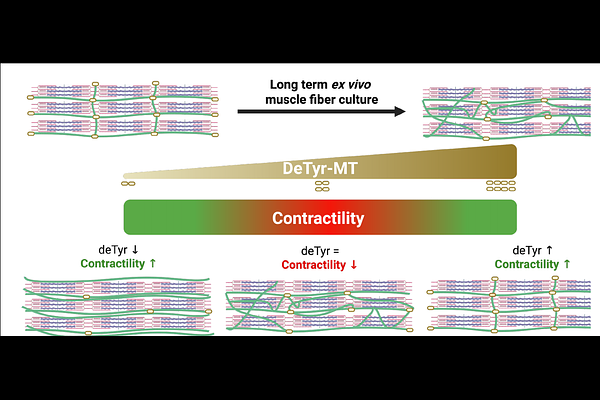
AbstractAlthough microtubules (MT) are established regulators of striated muscle mechanics, how MT lattice organization and post-translational modifications (PTM) individually shape contractility in healthy skeletal muscle fibers remains incompletely understood. We used an ex vivo single muscle fiber culture under unloading, examining acetylation and detyrosination (deTyr). During long-term 2D culture, the MT lattice was disrupted by transverse MT depletion without changes in MT abundance. In individual fibers, MT structure, but not abundance, positively correlated with sarcomere shortening non-linearly. When fibers were cultured in 3D hydrogels, the MT lattice was similarly disrupted, yet shortening was preserved, with increased longitudinal MTs and decreased deTyr-MTs. Pharmacologically, contractility increased with either a decrease (parthenolide) or an increase (Taxol) in deTyr-MTs, and Taxol further rescued the MT lattice. Our findings identify MT organization and detyrosination, rather than MT abundance, as key determinants of muscle fiber contractility, positioning deTyr-MT as a load-responsive, bidirectional marker relevant to disuse atrophy and aging.