Circadian temperature compensation is intrinsically linked with metabolism and redox signaling

Circadian temperature compensation is intrinsically linked with metabolism and redox signaling
Xu, Y.; Mori, T.; Mehra, H.; Ustione, A.; Tanaka, K.; Kitaguchi, Y.; Uriu, K.; Nakanishi, S.; Piston, D. W.; Vinyard, D.; Johnson, C. H.
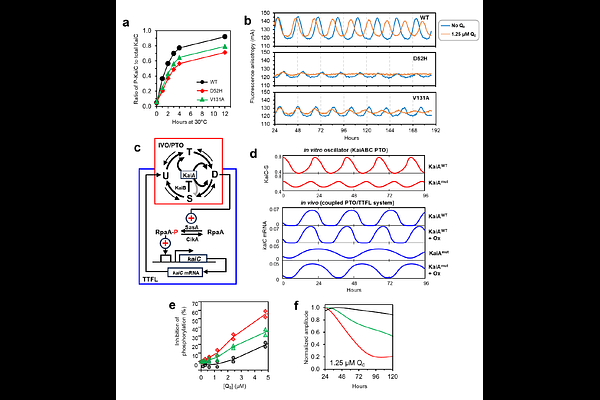
AbstractCircadian rhythms are a universal property of organisms, and a defining property of these oscillators is the ability to maintain a precise period at different temperatures. Indeed, the discovery in the 1950s of this property, known as "temperature compensation," was a watershed event in our understanding of biological timekeeping. Since that time, however, almost no general principles have emerged that uncover the mechanistic basis of how circadian timekeepers defy the rules" of temperature dependence of biochemical reactions. A genetic investigation of circadian temperature compensation revealed that the sensing of metabolism and ensuing modulation of the core mechanism preserves a constant circadian period. Intracellular redox sensing of metabolic rate is intrinsic to this compensation, and this relationship is conserved in bacterial and mammalian cells. These insights explain previously inexplicable observations of the interaction between redox reactions and circadian timekeeping. These results introduce a previously unknown linkage between temperature compensation and metabolism.