Time-Resolved Neuronal Network Dynamics Distinguish Pathological States in Organoid Models

Time-Resolved Neuronal Network Dynamics Distinguish Pathological States in Organoid Models
McCrimmon, C. M.; Sinha, P.; Cao, Q.; Monsoor, T.; Sharma, K.; Turali, M. Y.; Samarasinghe, R.; Roychowdhury, V.
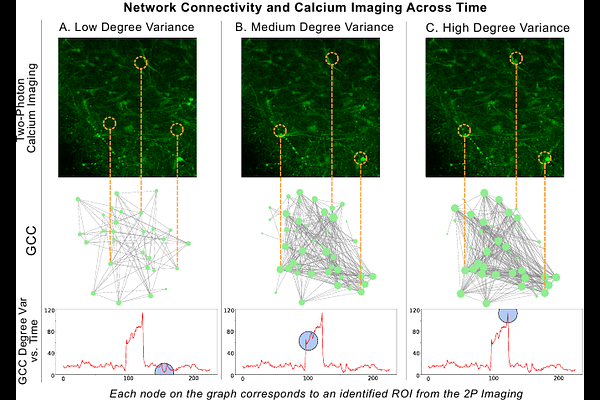
AbstractHuman brain assembloids offer a powerful platform for modeling neurological diseases, yet comprehensive methods for analyzing their complex network dynamics are lacking. Here, we developed a time-resolved network analysis pipeline that extracts quantitative biomarkers from two-photon calcium imaging, enabling the detection of subtle differences between disease and control models. We applied this pipeline to assembloids containing a pathogenic MAPT p.R406W variant -- clinically associated with an Alzheimer's disease-like phenotype -- and their isogenic controls. Our analysis revealed that mutant networks exhibit significantly increased degree variance and clustering. This indicates a "hub-like", interconnected topology prone to hypersynchrony, a finding that parallels the network hyperexcitability and seizure-like features observed in in-vivo models of Alzheimer's disease. Furthermore, a Random Forest classifier trained on these dynamic network features distinguished between diseased and control states with high accuracy (F1 score = 0.90). These results establish that dynamic network properties can serve as potent biomarkers for identifying pathological states in assembloid models, providing a quantitative framework to investigate disease mechanisms and potential therapeutic interventions.