Relapse-founding cancer persister cells in follicular lymphoma

Relapse-founding cancer persister cells in follicular lymphoma
Atkins, O.; Hung, M. S.; Song, O.-R.; Chen, B.; Maybury, B.; Edmondson, C.; Tesson, B.; Huet, S.; Salles, G.; Howell, M.; Reinhardt, H. C.; Fitzgibbon, J.; Okosun, J.; Zhang, L.; Calado, D. P.
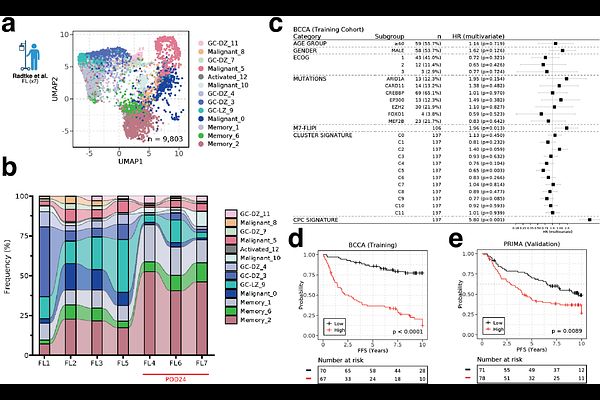
AbstractFollicular lymphoma (FL) is an incurable, prototypical relapse-remitting cancer, implying the existence of therapy-persistent cells that survive frontline treatment and seed disease recurrence1-3. However, these persister cells remain difficult to study directly in patients because immediate post-treatment sampling is ethically and practically challenging. Using a genetically defined mouse model that allows sampling of persistent cells immediately after frontline R-CHOP therapy, we prospectively isolate and functionally define relapse-founding cancer persister cells (CPC). The CPC is an IgM memory-like B-cell with high germinal center re-entry capacity. This state represents a discrete component of a heterogeneous residual pool indicating that residual disease is polytypic and that relapse potential may depend on which cells persist rather than on residual tumour burden alone. By integrating mouse CPC with human FL datasets, we show that an analogous transcriptional programme is detectable at diagnosis and is enriched in patients with inferior clinical outcome across independent cohorts4,5. These findings support the concept that relapse risk is linked to a conserved, genotype-agnostic CPC programme present before therapy. To explore therapeutic vulnerabilities, we developed a scalable in-vitro platform that models the CPC-like state and used it to identify sensitivity to histone deacetylase inhibition. Romidepsin and panobinostat killed CPC-like cells in-vitro, and decreased therapy-persistent cells after R-CHOP treatment in-vivo and in patient-derived organoids. Together, these data define a tractable CPC state in FL, with a validated clinical readout and an immediately testable therapeutic entry point, opening CPC-directed strategies for durable FL control.