Cellular Stress Tolerance Governs Genetic Transformability in Recalcitrant Candida Species

Cellular Stress Tolerance Governs Genetic Transformability in Recalcitrant Candida Species
Cotter, C. J.; Carper, D. L.; Giannone, R. J.; Trinh, C. T.
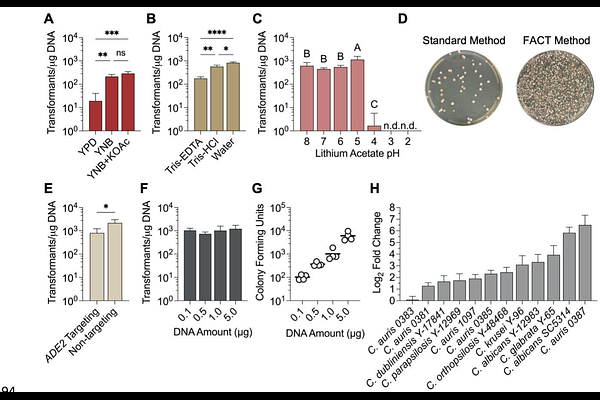
AbstractCandida species are fungal pathogens whose rapidly increasing antifungal resistance poses a substantial public health challenge. High-throughput CRISPR-based screening could accelerate antifungal target discovery, yet its application in Candida has been limited by low DNA transformation efficiency. Chemical transformation exposes cells to environmental stresses to permit DNA uptake, but the physiological constraints on transformability remain poorly defined. Here, we show that genetic transformability in C. albicans is governed by the cellular capacity to withstand and recover from transformation-induced stress. Nutrient limitation markedly enhances transformation efficiency, while extracellular pH and lithium acetate chemistry strongly modulate this response. Systems-level proteomic analyses reveal that nutrient limitation and transformation chemistry prime oxidative stress tolerance, and transformation efficiency correlates with the expression of oxidative stress response proteins. Guided by these insights, we developed a generalizable fungal advanced chemical transformation (FACT) method that increases transformation efficiency across diverse Candida species and enables robust pooled CRISPR screening.