Estimating Cardiac 5-HT2B Safety Margins for Repeated Low-Dose Psilocybin Using an Exposure-Response Model

Estimating Cardiac 5-HT2B Safety Margins for Repeated Low-Dose Psilocybin Using an Exposure-Response Model
Tyler, W. J.; Sellers, E.; McDonnell, M. B.
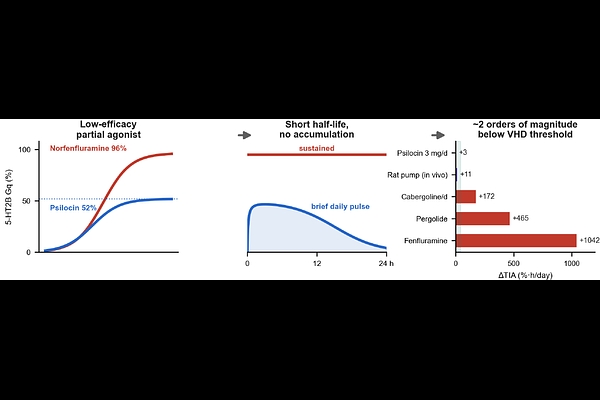
AbstractRepeated low dose psilocybin is being developed as a scalable outpatient treatment for mood and anxiety disorders, but chronic exposure raises concern because psilocin binds the cardiac serotonin 5HT2B receptor, whose sustained agonism causes drug induced valvular heart disease (VHD). We evaluated this risk using an exposure response model that incorporates functional efficacy and exposure duration rather than binding affinity alone. Plasma psilocin concentrations were converted into the time integrated increment in 5HT2B Gq signaling above endogenous serotonergic tone (deltaTIA) and calibrated against drugs and conditions with known valvular outcomes. All modeled exposures known to cause human VHD scored deltaTIA greater than or equal to +172 % h/day, whereas exposures not associated with VHD scored less than or equal to +28. A candidate 3 mg daily psilocybin regimen scored deltaTIA +3, roughly two orders of magnitude below the weakest valvulopathic exposure. This safety margin arises from low-efficacy partial agonism of psilocin at 5HT2B (Emax ~ 51.8% of serotonin, compared with 96% for norfenfluramine) and its short half-life (~ 2.5 h), which prevents accumulation and produces brief daily receptor engagement. In support of the model, rats receiving continuous psilocin for 12 days at plasma concentrations ~ 2.4 fold above the projected human peak for 3 mg daily psilocybin showed no valvular lesions by blinded histopathology. This exposure duration however cannot exclude slowly developing fibrosis. Emerging human data, including serial echocardiography in repeated LSD microdosing and a large observational cohort, are also agreement with the model. Collectively, these findings suggest a favorable safety margin for daily, subhallucinogenic psilocybin use in clinical indications. Nevertheless, continued pharmacological and clinical investigations should include prospective echocardiographic monitoring to advance the clinical safety profile of sub-hallucinogenic psilocybin and support its evaluation across a broad array of therapeutic programs.