Impact of Sex on Heroin Intravenous Self-Administration by Heterogeneous Stock Rats

Impact of Sex on Heroin Intravenous Self-Administration by Heterogeneous Stock Rats
Taffe, M. A.; Mehl, S. L.; Rahman, S. R. M. U.; Grant, Y.
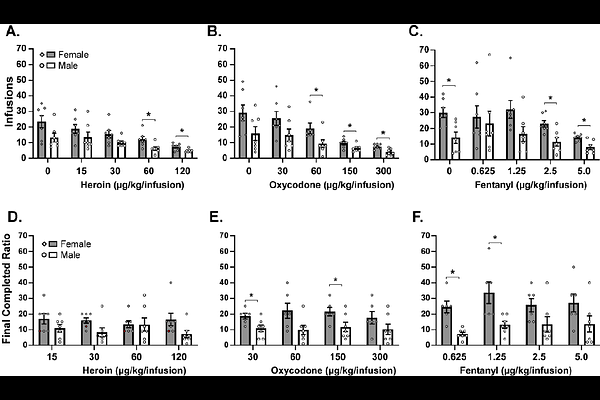
AbstractBackground: Intravenous self-administration (IVSA) of opioids by rats has been shown frequently to exhibit no sex differences, in many cases a higher intake of females, and only rarely higher rates in males. A diversity of methodological parameters (opioid identity, training doses, rat strain, session duration) makes it difficult to identify consistent contributions to these outcomes. Objective: To determine if Heterogeneous Stock (HS) rats derived from 8 founder strains differ by sex in the IVSA of opioids. Methods: Male and female Heterogeneous Stock (N=7-8 per sex) rats were permitted to self-administer heroin (20 g/kg/infusion) in 2 hour sessions under a Fixed Ratio 1 schedule of reinforcement. After acquisition, animals completed sessions in which different infusion doses of heroin (0, 15, 30, 60, 120 g/kg/infusion), oxycodone (0, 30, 60, 150, 300 g/kg/infusion) and fentanyl (0, 0.625, 1.25, 2.5, 5.0 g/kg/infusion) were assessed. Next, animals were evaluated on doses of heroin (15, 30, 60, 120 g/kg/infusion), oxycodone (30, 60, 150, 300 g/kg/infusion) and fentanyl (0.625, 1.25, 2.5, 5.0 g/kg/infusion) under a Progressive Ratio schedule. Anti-nociceptive effects of heroin (0.56-2.4 mg/kg, s.c.) were examined with a warm water tail-withdrawal assay. Results: Female HS rats consistently self-administered more infusions of opioids, including heroin during acquisition, all three opioids during FR-1 dose substitution and of oxycodone and fentanyl in the PR procedure. Male rats were moderately more sensitive to the anti-nociceptive effects of heroin. Conclusions: Female rats drawn at random from a genetically diverse population self-administer opioids at higher rates than their male counterparts.