Rank-Resolved Multi-Engine Docking and Optuna-Optimized Re-Ranking with ProDock for Virtual Screening

Rank-Resolved Multi-Engine Docking and Optuna-Optimized Re-Ranking with ProDock for Virtual Screening
Le, L. H. S.; Pham, T.-A.; Tran, N.-T. N.; Van-Nguyen, P.-C.; Phan, T. L.; Truong, T. N.
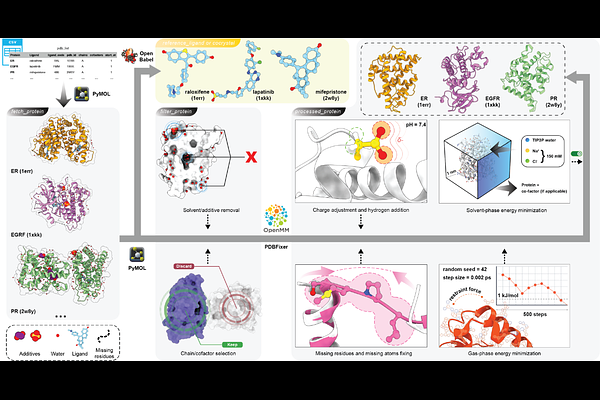
AbstractFalse positives in virtual screening often arise when a single docking score or top-ranked pose is treated as sufficient evidence for binding. We extend the previously introduced ProDock software from a database-backed docking platform into a rank-resolved, multi-engine workflow for automated preparation, docking, pose analysis, and optimized re-ranking. The extended workflow combines local docking with GNINA and global docking with DiffDock with pose-level descriptors, namely binding-site occupancy, ligand localization, interaction-fingerprint similarity, and steric clash counts, together with Optuna-based threshold optimization. Across 43 DUDE-Z targets, the archived benchmark outputs reported higher enrichment values for CNN-based GNINA scores after optimization. CNNaffinity PR-AUC changed from 0.197 to 0.294 and LogAUC from 0.708 to 0.763, whereas empirical affinity ROC-AUC changed from 0.770 to 0.758. Structural investigation of re-docked actives showed that re-ranked poses were more native-like, with improved binding-site occupancy, reduced centroid displacement, and greater recovery of co-crystal interactions. The extension provides a reproducible framework for combining complementary docking engines with interpretable pose-level metrics before hit selection, thereby aiding the identification of true-positive candidates in virtual screening.