Nonlocal Proliferation and Explosive Tumour Dynamics: Mechanistic Modelling and Bayesian Inference

Nonlocal Proliferation and Explosive Tumour Dynamics: Mechanistic Modelling and Bayesian Inference
Kavallaris, N.; Javed, F.
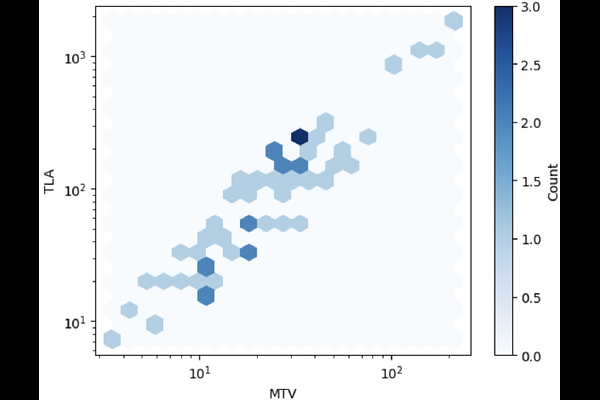
AbstractWe introduce a mechanistic, nonlocal tumour-growth model designed specifically to capture explosive dynamics that are not adequately explained by standard logistic reaction-diffusion descriptions. The motivation is empirical: the universal scaling law reported in {Nature20} provides compelling cross-sectional evidence of superlinear tumour activity versus tumour burden, but as a phenomenological relationship, it does not by itself supply a dynamical mechanism, nor does it rigorously describe how explosive growth emerges, how fast it develops, or how spatial interactions and tissue boundaries influence it. Our model addresses this gap by incorporating nonlocal proliferative feedback-cells respond to a spatially aggregated neighbourhood signal-and a singular, Kawarada-type acceleration that produces ''quenching'': tumour density stays bounded while the proliferative drive becomes unbounded as the aggregated signal approaches a critical threshold. This offers a concrete mechanistic route to explosive escalation consistent with physical boundedness. We analyse the model under no-flux (Neumann) boundary conditions, appropriate for reflecting tissue interfaces. In the spatially homogeneous setting we prove finite-time onset of the explosive regime and obtain explicit rates for how rapidly it is approached. For spatially heterogeneous perturbations we derive a transparent spectral stability theory showing how the interaction kernel selects spatial scales and how the singular acceleration tightens stability margins as the explosive threshold is approached. These results provide interpretable links between nonlocal interaction structure, boundary effects, and the emergence of rapid growth. Finally, to connect mechanism to data in the spirit of {Nature20}, we embed the model in a Bayesian inference framework that treats the interaction kernel and the acceleration strength as unknown and learned from tumour-growth observations. This enables uncertainty-aware estimation of explosive onset times, escalation rates, and stability margins, while positioning the scaling law of {Nature20} as an observable signature that our mechanistic model can explain and quantify rather than merely fit.