Antimicrobial-resistance plasmids encode Evangelion, a widespread DUF4062 anti-phage defence family

Antimicrobial-resistance plasmids encode Evangelion, a widespread DUF4062 anti-phage defence family
Ibarra-Chavez, R.; Azam, A. H.; Chihara, K.; Djurhuus, A. M.; Gottlieb, K. A.; Tamura, A.; Sicheritz-Ponten, T.; Madsen, J. S.; Kiga, K.
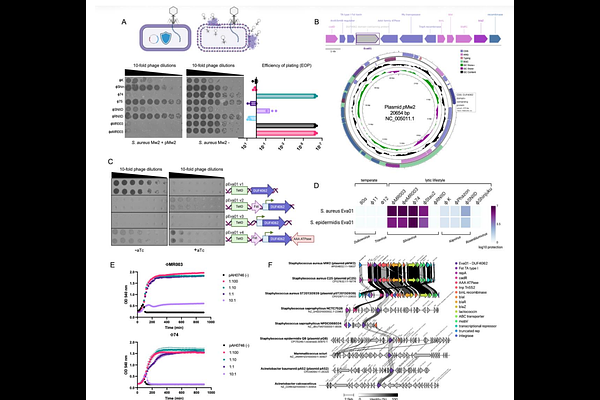
AbstractMany bacterial anti-phage defence systems are encoded by mobile genetic elements, yet much of this antiviral repertoire remains undiscovered. Antimicrobial-resistance plasmids are well known for disseminating antibiotic-resistance genes, but their contribution to bacterial immunity remains largely unexplored. Using phenotype-guided interrogation of a naturally occurring methicillin-resistant Staphylococcus aureus plasmid, we identify Evangelion, a widespread family of single-gene anti-phage defence systems in which a conserved DUF4062 core is coupled to a diversified auxiliary region required for defence activity. Evangelion systems are enriched on antimicrobial-resistance plasmids but are distributed across diverse bacterial hosts and mobile genetic elements, revealing an evolutionarily conserved defence architecture that has diversified through horizontal gene transfer and adaptation to distinct phage environments. Genetic, structural and evolutionary analyses support a model in which Eva01 senses intracellular phage replication-associated processes and couples activation of a DUF4062 effector to NAD depletion and abortive infection. Together, our findings define a previously unrecognised family of mobile anti-phage defence systems, establish DUF4062 proteins as a new component of the bacterial anti-phage repertoire, and demonstrate that phenotype-guided interrogation of mobile genetic elements provides a powerful strategy for discovering defence systems beyond the reach of current computational approaches.