Ribonuclease L Regulates Antiviral Responsiveness through Cleavage of XBP1 mRNA

Ribonuclease L Regulates Antiviral Responsiveness through Cleavage of XBP1 mRNA
Takenaka, Y.; Akiyama, Y.; Inaba, T.; Shinozuka, D.; Aoyama, K.; Ogasawara, R.; Kunii, N.; Abe, T.; Morita, E.; Tomioka, Y.; Ivanov, P.
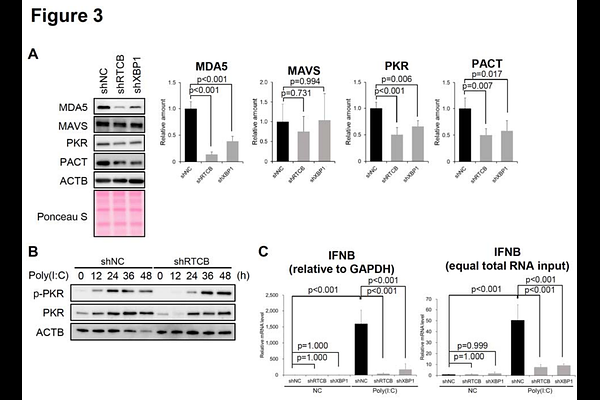
AbstractDuring viral infection, viral replication perturbs endoplasmic reticulum (ER) homeostasis and triggers the unfolded protein response (UPR). XBP1s, a transcription factor generated by one branch of the UPR, is known to potentiate both innate and adaptive immunity, but its role in antiviral responses remains incompletely understood beyond its ability to augment type I interferon (IFN) mRNA induction. Here, we show that XBP1s positively regulates the RIG-I-like receptors (RLRs), ribonuclease L (RNase L), and protein kinase R (PKR) pathways, indicating that it enhances all three major antiviral response pathways. We further show that RNase L activation rapidly decreases XBP1 mRNA levels in an RNase activity-dependent manner, leading to a prompt reduction in XBP1s expression. Consistent with this, RNase L deletion significantly increased both thapsigargin-mediated XBP1s induction and XBP1s expression following Japan encephalitis virus infection. Poly(I:C)-induced IFNB mRNA expression was significantly enhanced in RNase L-knockout cells. This enhancement was completely abolished by RNase L reconstitution. XBP1 knockdown also significantly attenuated IFNB mRNA expression in RNase L-knockout cells. These findings suggest a negative-feedback loop in which RNase L suppresses XBP1s, thereby fine-tuning antiviral responsiveness during viral infection.