Starvation-induced autophagy occurs independently of the ATG1 complex in Chlamydomonas

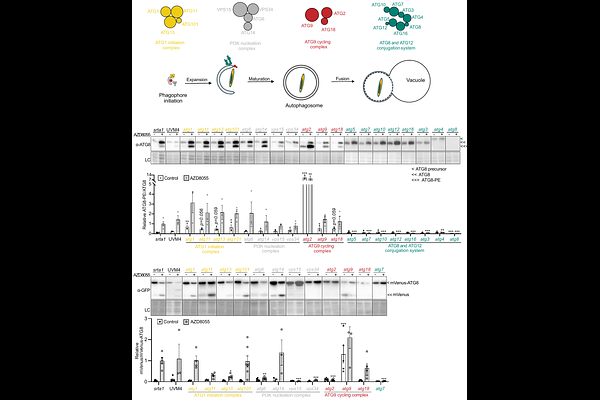
Starvation-induced autophagy occurs independently of the ATG1 complex in Chlamydomonas
Zou, Y.; Wu, Y.; Stael, S.; Moschou, P. N.; Zhuang, X.; Minina, A. E. A.; Bozhkov, P.
AbstractThe survival of eukaryotes during starvation depends on effective nutrient recycling via autophagy. Accordingly, loss of autophagy-related (ATG) proteins, including the nutrient-sensing ATG1 kinase complex, typically results in reduced fitness or lethality under nutrient limitation. The green alga Chlamydomonas reinhardtii provides a tractable model for autophagy studies, primarily because its ATG repertoire is encoded by single-copy genes. We generated a full panel of ATG deletion mutants and examined their growth and autophagy during starvation. Surprisingly, starvation-induced autophagy occurred independently of the ATG1 complex components (ATG1, ATG11, ATG13, and ATG101), challenging the canonical ATG1 -dependent model and suggesting an alternative pathway.