Insulin Signaling Functions as a Topological Switch That Couples Aging and Heat Stress Responsiveness

Insulin Signaling Functions as a Topological Switch That Couples Aging and Heat Stress Responsiveness
Widuch, M. J.; Siepka, S. M.; Carthew, R. W.
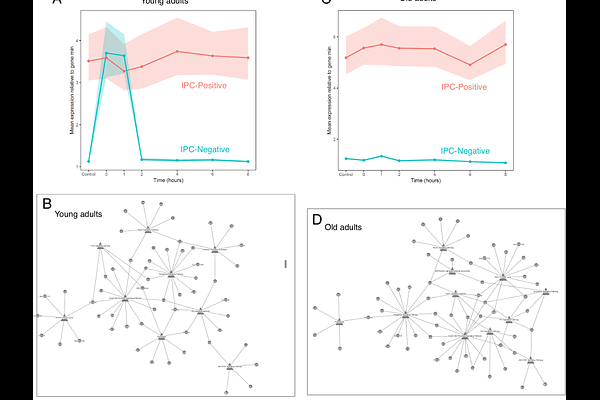
AbstractWhile aging and thermal stress are phenotypically intertwined, their transcriptomic signatures remain paradoxically distinct in Drosophila. Here, we demonstrate that this parallel modularity is not an inherent genomic constraint but is actively maintained by Insulin/IGF-1 signaling (IIS). Using transcriptomic analysis, we show that high IIS activity partitions the genome into orthogonal regulatory layers where aging and heat stress function as independent additive inputs. Systemic attenuation of IIS triggers a transition to an integrated architecture. In this state, the genomic perception of heat stress becomes age-dependent, enabling a hyper-adaptive induction of heat shock proteins in old adults, effectively reversing the typical age-related decline in proteostasis. We propose that the IIS pathway functions as a topological switch, shifting the genome from a modular growth-mode to an integrated maintenance-mode. Thus, dampening the response to heat stress with age is an adaptable regulatory state rather than an inevitable consequence of cellular senescence.