DyME: An MD-based engine exploiting HTP mutagenesis for protein engineering and recognition mimicry

DyME: An MD-based engine exploiting HTP mutagenesis for protein engineering and recognition mimicry
Guillem-Gloria, P. M.; Ruiz-Gomez, G.; Pisabarro, M. T.
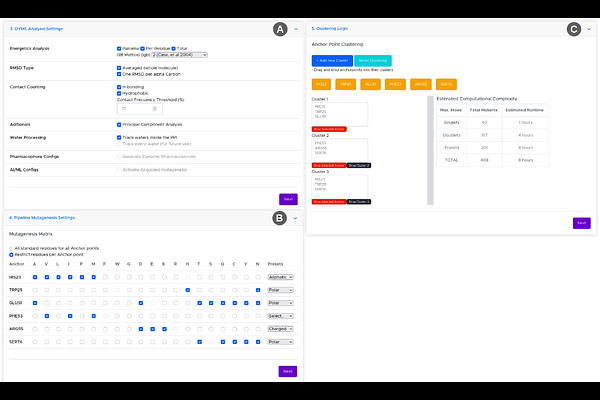
AbstractProtein recognition mimicry is of great interest in the field of molecular bioengineering and rational design, with mutagenesis frequently employed to analyze the effects of altering amino acids involved in molecular recognition. The conformational and energetic effects of such alterations can be investigated in detail with the help of molecular dynamics (MD) methodologies. While existing MD-based computational tools can be used to explore a particular set of mutations at a time, suitable for small-scale studies, high-throughput (HTP) exploration of protein recognition for engineering purposes would greatly benefit from an integrative platform that streamlines preparation, mutagenesis, simulation and post-processing of up to several thousand molecular systems, along with robust tools for comprehensive and straightforward comparative analysis. DyME (Dynamic Mutagenesis Engine) is a distributed platform that enables systematic investigations of protein recognition mimicry by combining HTP mutagenesis, solvated MD simulations and a Toolbox for comparative analysis (TCA), including interfacial water-site mapping. DyME uses 3D structural information of any protein-protein or protein-DNA complex as input. Its automated MD-based mutagenesis engine facilitates systematic investigation of how site-specific alterations affect recognition, enabling the organization of single, double and triple modifications into combinatorial libraries for comprehensive comparative analysis. In DyME, relevant MD trajectory-derived data is scavenged and stored into a central database, providing aggregation capabilities that ease multi-feature analysis across an extensive collection of simulations. An interactive web-GUI and specialized widgets simplify preparation and efficient molecular and numerical comparative exploration. DyMEs capabilities are evaluated using available experimental data. Its source code is available at https://github.com/pisabarro-group/DYME