STRESS HISTORY ESTABLISHES A TRANSIENT TOLERANT STATE THAT SHAPES ANTIBIOTIC SURVIVAL UPON RESUSCITATION

STRESS HISTORY ESTABLISHES A TRANSIENT TOLERANT STATE THAT SHAPES ANTIBIOTIC SURVIVAL UPON RESUSCITATION
Abbott, K.; Hardo, G.; Li, R.; Bradley, J.; Zarkan, A.; Bakshi, S.
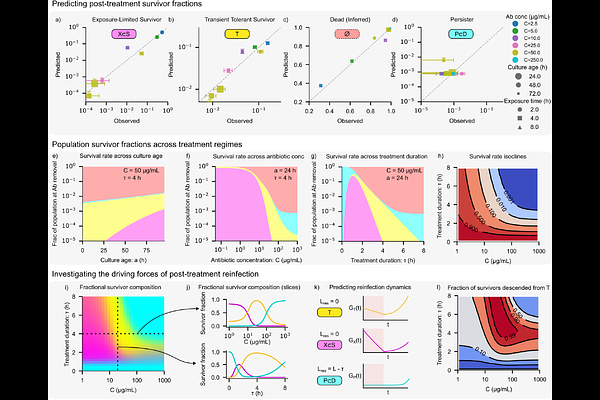
AbstractAntibiotic treatment failure, often driven by non-genetic mechanisms such as tolerance and persistence, remains a major global health challenge. {beta}-lactams, the most widely prescribed antibiotic class, are particularly compromised by tolerance in dormant, non-growing cells; yet, how these drugs act on cells resuscitating from dormancy remains poorly understood. Here, we investigate the resuscitation phase at an unprecedented scale using Hi-DFA (High-throughput Dynamic Fate Analyser), a single-cell microfluidic platform integrating time-lapse imaging with machine-learning-based image analysis for dynamic cell-fate tracking. We identify a distinct survival strategy: a significant fraction of resuscitating cells transiently slow their growth, facilitating survival upon {beta}-lactam exposure. This `transiently tolerant' phenotype is considerably less frequent in unstressed, exponentially growing cells, indicating that prior starvation history predisposes cells to this state. Using simulated in vitro pharmacokinetic treatment profiles, we show that suboptimal dosing selectively enriches for this transient tolerance state. A population dynamics model built from this single-cell antibiotic-response data suggests that these transient-tolerant cells, not typical starvation-triggered persisters, may be the primary drivers of rapid population regrowth post-treatment under clinically relevant conditions. Together, our findings define a distinct class of antibiotic survival shaped by stress history and treatment profile, offering a quantitative framework for optimising antibiotic dosing strategy.