A Hierarchy-aware Gene Exploration Platform for Multi-layered Toxicogenomic Analysis: A Case Study on Acetaminophen-induced Hepatotoxicity

A Hierarchy-aware Gene Exploration Platform for Multi-layered Toxicogenomic Analysis: A Case Study on Acetaminophen-induced Hepatotoxicity
Kim, M.; Cui, Y.; Kim, M. G.
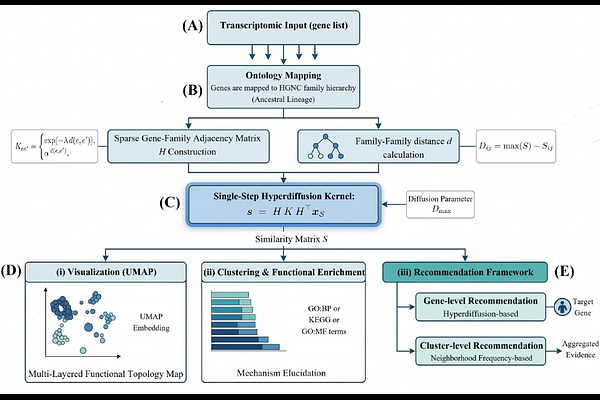
AbstractBackground: The interpretation of high-dimensional transcriptomic data remains a major challenge in mechanistic toxicology and drug safety assessment. Conventional clustering approaches based solely on expression profiles often fail to capture intrinsic biological relationships among genes, limiting interpretability and downstream analysis. Methods: We developed a hierarchy-aware gene exploration platform that integrates structured biological knowledge from the HUGO Gene Nomenclature Committee (HGNC). The core of the framework is a similarity kernel based on a single-step hyperdiffusion formulation (H K H^top), which embeds gene family hierarchy into the similarity space. The platform is implemented as an interactive web application supporting Uniform Manifold Approximation and Projection (UMAP) visualization, Leiden clustering, functional enrichment analysis, and hierarchy-based gene recommendation. Results: Applied to a transcriptomic dataset of acetaminophen-induced acute liver failure (APAP ALF), the proposed approach achieved a 33.8-fold improvement in functional coherence compared to an expression-only baseline. The hierarchy-aware embedding produced compact and biologically consistent clusters, enabling identification of key toxicological modules, including disruption of RNA processing, extracellular matrix remodeling, and impairment of lipid transport. In addition, the framework detected small but highly significant regulatory modules associated with epigenetic reprogramming. Conclusion: By incorporating biological hierarchy into gene similarity, the proposed platform enhances the interpretability of transcriptomic analysis and enables structured exploration of functional relationships. This approach provides a practical framework for mechanistic insight generation and supports more transparent and reproducible analysis in toxicogenomics.