Col-Ovo: Smartphone-based artificial intelligence for rapid counting of Aedes mosquito eggs under field conditions

Col-Ovo: Smartphone-based artificial intelligence for rapid counting of Aedes mosquito eggs under field conditions
Almanza, J.; Montenegro, D.
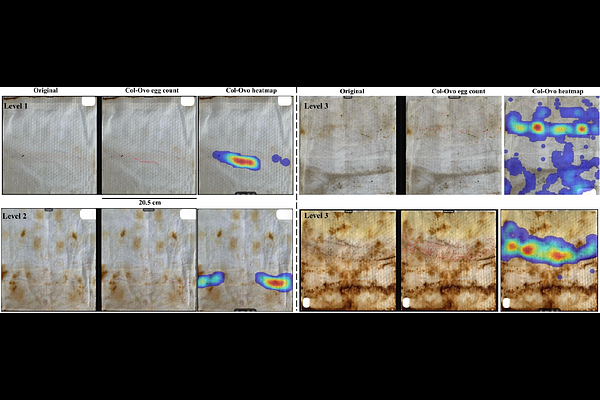
AbstractBackground: OviCol has recently been proposed as a disruptive strategy for the surveillance and control of synanthropic Aedes mosquitoes, vectors of dengue, Zika, and chikungunya viruses. The approach integrates monitoring and control through ultra-low-cost ovitraps (~0.2 USD), bioattractants, and egg inactivation using hot water. However, large-scale ovitrap surveillance generates thousands of egg substrates that require time-consuming manual counting, creating a major operational bottleneck. To address this limitation, we developed Col-Ovo, an artificial intelligence-based tool for automated counting of Aedes aegypti eggs from real field samples, together with OviLab, a digital platform for annotation, curation, and management of entomological image datasets. Methodology/Principal Findings: The detection model was trained using YOLOv11m on a dataset of 275 oviposition substrates (20.5 cm strips) collected under routine operational conditions. Images were captured in situ without preprocessing and included substrates heavily stained by bioattractants such as blackstrap molasses and dry yeast (Saccharomyces cerevisiae), as well as sand and particulate debris, reflecting realistic field conditions. The system was designed to operate with standard smartphone images and tolerate compression artifacts produced by messaging platforms such as WhatsApp. Performance was evaluated by comparing automated egg counts with expert manual counts and with virtual-human counts conducted in OviLab using >200% image magnification. Col-Ovo achieved >95% agreement with expert counts and 88% agreement with OviLab while reducing processing time from approximately 15 minutes to <3 seconds per sample. Conclusions/Significance: Col-Ovo enables rapid, scalable quantification of Ae. aegypti eggs from smartphone images, addressing a critical operational barrier in ovitrap-based surveillance. The system requires no image preprocessing or specialized hardware and is accessible through a lightweight web interface supported by an AI architecture that allows retraining for new ecological contexts or additional Aedes species. Integrated with OviLab, this platform provides a flexible digital infrastructure that can strengthen routine vector surveillance and community-level control programs across regions where Aedes mosquitoes continue to expand.