Endogenous intronic RNA tightly controls Cas9/CRISPR-mediated gene editing in human cells

Endogenous intronic RNA tightly controls Cas9/CRISPR-mediated gene editing in human cells
Carneiro, A. L.; Proenca, J. T.; Valiollahi, E.; Barreto, V. M.
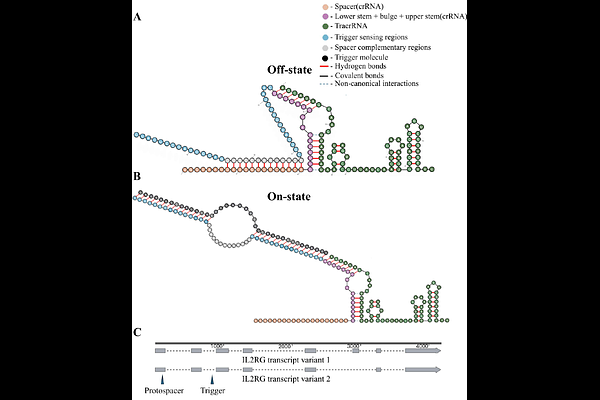
AbstractIn gene editing, CRISPR/Cas approaches are often limited by off-target effects. In in vivo approaches involving multiple cell types, off-targets may result from unintended targeting of the wrong cells. In this work, we propose a solution to this limitation by using a transcribed intron of the target gene as an endogenous trigger (intron triggers) for a novel conditional guide RNA (intcgRNA). In vitro, intcgRNAs were responsive to the presence of the trigger. As a proof-of-concept, the human IL2 receptor subunit gamma gene (IL2RG) was then targeted using both the intcgRNA and the corresponding conventional crRNA in two cell lines: the lymphocytic HPB-ALL cell line, where IL2RG is highly expressed, and the epithelial HeLa cell line, where it is not. Sanger sequencing revealed that the crRNA and intcgRNA Cas9 complexes edited IL2RG with similar efficiency in HPB-ALL, whereas only the crRNA edited IL2RG in HeLa. This shows that intcgRNA avoids targeting unwanted cells that do not express the target gene, which is particularly relevant for in vivo targeting. The triggers of choice for conditional guides have been microRNAs, but as short intronic RNAs are far more diverse, trigger introns could become biomarkers of cell identity that improve the precision of CRISPR-based manipulations in vivo.