Pushing the limits of SCP: bacSCP, a proof-of-concept study to investigate heterogeneity of bacteria by single cell proteomics.

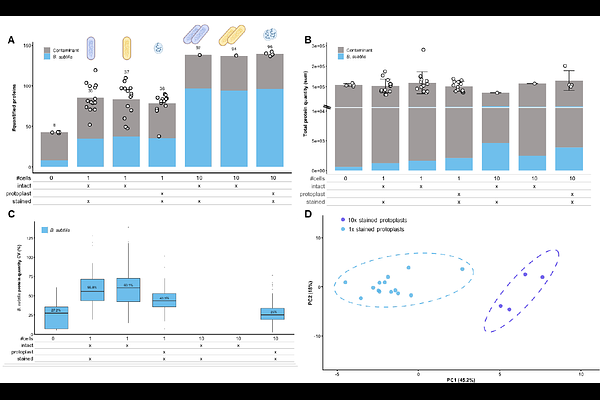
Pushing the limits of SCP: bacSCP, a proof-of-concept study to investigate heterogeneity of bacteria by single cell proteomics.
Leodolter, J.; Thierer, T.; Mechtler, K.; Matzinger, M.
AbstractSingle-cell proteomics (SCP) has emerged as a powerful approach to quantify protein expression variability at cellular resolution, yet most state-of-the-art workflows are tailored to eukaryotic cells with only one study exploring how single bacteria can be analyzed by mass spectrometry. Here, we established bacSCP, a protocol extending SCP to bacterial cells, facing analytical challenges such as the thick bacterial cell wall hampering lysis, the extremely small cell size and resultant low protein content, and the consequently relatively high level of contaminating proteins from external sources. Using this bacSCP pipeline, we quantified more than 50 bacterial proteins from single Bacillus subtilis and Escherichia coli cells. Upon heat stress, we reproducibly observed up to 8-fold upregulation of chaperones including GroEL, GroES, and ClpC for a B. subtilis dmcsB strain. Importantly, single-cell measurements revealed potential heterogeneity within the heat-stressed subpopulation, enabling interrogation of stress-response variability at the proteome level. These results demonstrate the feasibility of bacSCP and provide a foundation for studying bacterial stress adaptation and phenotypic diversity with single-cell proteomic resolution.